
Metrics for the Internet, Information Technology,
and Service Management
Over 540 Objective
Metrics Defined
83 Graphical Metric Reports
show over 240 metrics
Compliant with ITIL
ISO 20000
IT Service Management
IT Metrics are not understood by many business executives. What non-IT business execurives often focuses on is the one metric that they understand - the cost of IT. This in turn leads to a continuous cycle of IT budget reductions.
Most IT metrics efforts lack relevance to the business and are not well linked to business outcomes. They tend to be IT focused, such as WAN availability or server downtime. It is difficult for the business to understand how these measures relate to its objectives, and they provide little insight into the value that IT delivers.
CIOs must create a scorecard and service level agreements that:
-
Relate to the enterprise and its management team. Server availability, network throughput, help desk call volumes, capacity utilization, and other IT operational metrics are not relevant to business executives. These types of metrics need to be translated into something enterprise management understands, such as availability of business applications or the cost to support a business area. The IT-operational metrics should be kept within IT unless they can be put in enterprise terms.
-
Relate to the enterprise strategic and tactical objectives. Enterprise executives are concerned with introducing new products and services, improving customer loyalty and satisfaction, increasing gross margins, and growing market share. IT metrics must be linked directly to these enterprise objectives, specifically demonstrating how IT initiatives contributed favorably to improving them.
Effective SLAs are extremely important to assure
effective Information Technology operations. The metrics used to measure and
manage performance to SLA commitments are the heart of a successful agreement
and are a critical long term success factor. Lack of experience in the use and
implementation of performance metrics causes problems for many organizations as
they attempt to formulate their SLA strategies and select and set the metrics
needed to support those strategies. Fortunately, while reaching for perfection
is difficult and costly, most organizations can achieve their objectives through
a carefully chosen set of simple-to-collect metrics. Hopefully, this paper
provides some insights into the "whys" and "hows" of this selection process.
The Metrics HandiGuide is the tool that can be used to accomplish that task.
At the heart of an effective Service Level Agreement (SLA) are performance metrics and they
-
Measure the right performance characteristics
to ensure that the client is receiving its required level of service and the
service provider is achieving an acceptable level of profitability
-
Can be easily collected with an appropriate
level of detail but without costly overhead, and
-
Tie all commitments to reasonable, attainable
performance levels so that "good" service can be easily differentiated from
"bad" service, and giving the service provider a fair opportunity to satisfy
its client.
The Metrics for the Internet, Information Technology
and Service Management HandiGuide is over
300 pages, defines 540 objective metrics, and contains
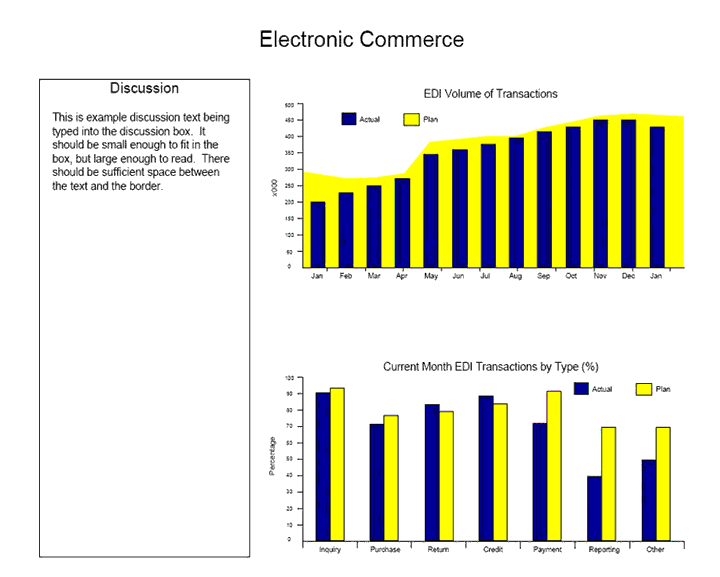
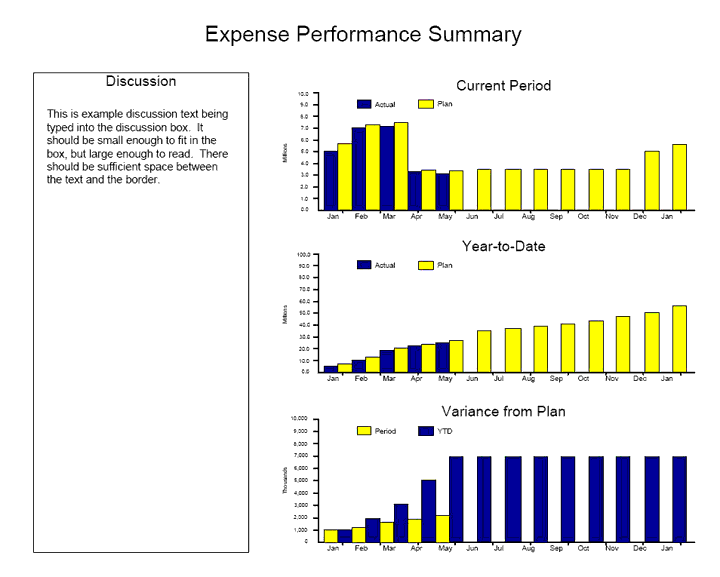
83 metric reports that show over 240 objective metrics.
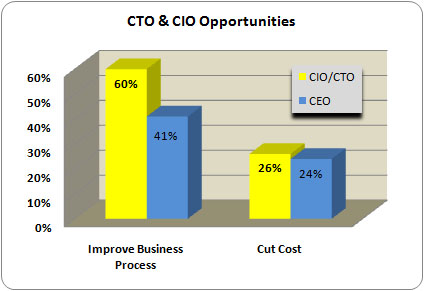
Operational Improvement Opportunities as defined by
CIO, CTO, and CEO
The metrics cover all areas of the Internet, Information Technology,
and Service Management -- including WIRELESS metrics which in turn includes mobile broadband specifications. In addition, there
are industry specific examples for financial services, distribution,
manufacturing, education, entertainment, government, hospitality, insurance,
medical, real estate and retail.
-
Organizational responsibilities defined
-
Metric process, design, and definition of 540
specific objective metrics
-
83 sample
metric reports - includes over 240 of 540 objective metrics
-
Graphic data presentation rules
-
A full metric report package is defined - a template
you can use right away
-
Wireless metrics examples are featured
-
Updated to comply with Sarbanes-Oxley
Sample Metrics Reports in Graphic Format
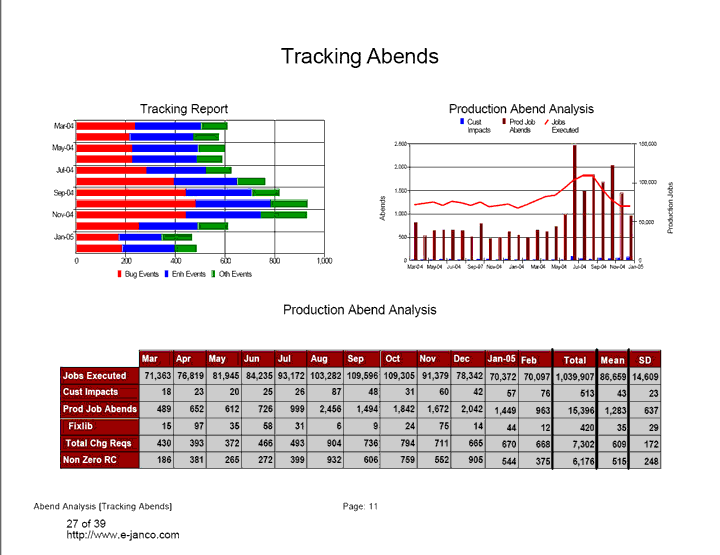
Click on the individual images above to to enlarge
Metric and IT Measurement News
Internet Misuse Concerns CIOs
When employees and
enterprise associates misuse the Internet there
are ramifications for and to your enterprise:
-
Higher operating expenses and
reduced productivity
-
Exposure to security problems such
as malware
-
Exposure to legal risks due to
inappropriate material
-
Wasted bandwidth to support the
misuse
-
Unlicensed software when users
download and install software from the
internet
-
Reputation risk from social
networking which can create opportunities for employees to leak confidential
information or spread damaging rumors
online - more info
Expenditures Closely Watched by CIOs and CFOs
In today's economy, all purchases are carefully
scrutinized to ensure that each new piece of hardware and software can
produce a rapid return on investment (ROI). However, even attractive and
accelerated paybacks are not enough to justify additional expenditures as
cautious CIOs and CFOs must continue to slow their technology spending in order
to ensure weathering the current economic conditions.
According to an annual survey of top CIOs from
multinational Fortune 1000 companies conducted by Goldman Sachs & Co.,
networking equipment emerged as one of the greatest potential areas for cost
reductions in 2009. The CIOs surveyed also indicated an intensified focus on
projects involving total cost of ownership (TCO) reductions, such as server
virtualization and server consolidation. Faced with severe budget constraints,
many CIOs also are delaying product upgrades and technology refreshes, despite
the fact that OEMs continue to release next-generation products in increasingly
rapid-fire succession.
As a result, increasing numbers of corporations are
embracing asset recovery strategies as part of their recession survival tactics.
Corporate network budgets, in particular, can be willing recipients of a welcome
boost from asset recovery since high-end routers and switches retain more value
than many other types of hardware. The keys to maximizing the value of surplus
technology in a down economy are determined by how, when and where to offload
unwanted gear as well as identifying the partner that can offer top dollar for
extraneous equipment along with unparalleled responsiveness and superior
customer attention. - more info
Metrics Key to CIO Success
CIOs frequently ask what IT should measure and
report to business executives. The key to success is choosing a small number of
metrics that are relevant to the business and have the most impact on business
outcomes. The basis for metrics that work are that they meet the
criteria for relevance and impact are investment alignment to business strategy,
business value of IT investments, IT budget balance, service level excellence,
and operational excellence.
Metrics should form the
core of an IT performance scorecard and should center around:
-
Alignment of IT initiatives, investments, and operational support
to the strategy of the enterprise
-
Value added that IT brings to the enterprise
-
Cost of new initiatives versus the cost of maintenance of
existing processes
-
System availability and ease of use
-
Health of systems and IT
function - more info
Easier to Cut Salaries than Lay-off Staff
Here's the good news: While companies certainly
have laid off huge numbers of employees since the economy first started to
implode, it appears many of them are doing everything they can to minimize the
number. From the Challenger, Gray & Christmas, Inc. press
release:

... employers announcing
job cuts have initiated more cost-cutting measures than employers that have not
cut payrolls. Companies that made permanent job cuts averaged an additional six
cost-cutting measures. Meanwhile, companies that have avoided layoffs averaged
less than three cost-cutting measures.
"There is a perception
out there that some companies have not made sufficient efforts to avoid layoffs
by making cutbacks in other areas. This perception is fueled, in part, by a
handful of examples of companies announcing job cuts while, at the same time,
rewarding top executives with large salaries, bonuses and extravagant perks.
However, these examples represent the exception," said Challenger chief
executive officer.
"It would also be a
mistake to assume that companies avoiding layoffs are doing so out of kindness.
While forging good will is certainly part of the decision for some companies,
many have simply cut to the bone already or never fully ramped up after the last
downturn. Other companies may have more workers than they need for current
business levels but are reluctant to enact widespread layoffs, knowing that a
recovery will mean recruiting and training all new workers.
"This may be why we have
seen an increase in the number of companies cutting salaries and other perks. It
is a lot easier to restore compensation and benefits than it is to re-hire and
re-train workers when the economy improves." - more info
PCI Compliance Has Benefits Beyond Mandated Requirements
PCI
compliance is used as a basis for guidance on fulfilling management
responsibility in relation to audits, and information on ensuring continual
improvement of IT security efforts. There is merchant confusion about all of
the PCI DSSs six main themes: Building and maintaining a secure network,
protecting cardholder data, maintaining a vulnerability management program,
implementing strong access control measures, monitoring and testing networks,
and maintaining an information security policy.
PCI as a
robust security standard has potential benefits beyond its immediate
requirements. A generic application of its principles can fulfill other
regulatory requirements for information security and privacy. PCI compliance is mostly information
security best practices. However, there is quite a bit of devil in the details
of the PCI requirements. There are over 250 detailed testing
procedures.
Penalties for noncompliance include higher transaction processing fees,
fines, and, in extreme cases, denial of credit card processing capabilities.
Violators also face legal fees, civil lawsuits, customer rejection and related
revenue loss, and other costs and losses.
Understanding the PCI authority structure is important in maintaining
control over PCI strategy and audits.
The PCI DSS
security requirements apply to all "system components." A system component is
defined as any network component, server, or application that is included in or
connected to the cardholder data environment. The cardholder data environment is
that part of the network that possesses cardholder data or sensitive
authentication data. Network components include but are not limited to
firewalls, switches, routers, wireless access points, network appliances, and
other security appliances. Server types include, but are not limited to the
following: web, database, authentication, mail, proxy, network time protocol
(NTP), and domain name server (DNS). Applications include all purchased and
custom applications, including internal and external (internet)
applications. - more info
Virus Targets Federal Law Enforcement
Federal law
enforcement systems have been targeted by a virus. The FBI and the U.S. Marshals
Service were forced to shut down parts of their computer networks after a
mystery virus struck the law-enforcement. The virus' type and origin are
unknown, but spokespeople for both agencies said agencies' access to the
Internet and e-mail was shut down while the issue was evaluated.
The U.S. Marshals confirmed it disconnected from the Justice
Department's computers as a protective measure after being hit by the virus; an
FBI official said only that that agency was experiencing similar issues and was
working on the problem.
In addition to their external networks, most
federal law enforcement agencies have an internal-only network to prevent
cyber-snoopers from sensitive data. Government regulations require agencies to
report any security issues to US-Computer Emergency Readiness Team
(US-CERT).
To protect
networks and information against
increasingly sophisticated threats, many organizations are deploying security in
layers. Some are finding that an efficient way to do this is by using unified
threat management (UTM) appliances.
- more info
Office 2000 is at End of Life
Microsoft told Office 2000 users that it will
discontinue security updates
for the aged suite in July as it drops all support for the software.
At the same time, the company also reminded users
that it's dumping the Office Update site at the end of July, part of an effort
to streamline update options.
Office 2000 falls off the support list on July 14
-- which is also Microsoft's "Patch Tuesday" for that month -- as it leaves what
the company calls "extended" support. From that point on, Microsoft will no
issue fixes, not even ones for critical vulnerabilities; instead, it expects
users to move on to a newer suite.
By policy, Microsoft supports business software
such as Office for a total of 10 years, half in "mainstream" support and the
second half in the more limited support. Security updates are delivered for the
entire 10-year stretch.
Microsoft launched Office 2000 in June
1999.
- more info
Security Risk Faced by Business Due to Lost of Laptops
Anytime and anywhere employees, temporary employees
and contractors can access and store enormous amounts of confidential data about
customers, employees and their organizations operations on laptops. When these
laptops are lost due to negligence or theft, the data is at risk if the
organization has failed to use such safeguards as encryption or anti-theft
technologies. Janco recommends implementing and monitoring strong Security Policies and
Procedures.
Most executive managements and IT professionals
believe the risk of having lost or stolen laptops will most likely increase or
stay the same (i.e., not improve) over the next 12 to 24
months. - more info
Business Record Management is Difficult at Best for Many CIOs
Several
studies have found that knowledge workers spend between 15 and 35 percent of
their time finding information. The requirement to find information quickly and
easily makes search technology a practical and essential tool with
a measurable return on investment (ROI).
However,
search engines are optimized to search web pages and documents and they still
fall short inside the enterprise when you consider the additional IT assets
stored in applications and other real-time sources of information like databases
and ERP Systems. These systems remain "unsearchable" by
many current search solutions and largely remain the domain of operational
reporting and business intelligence software. - more info
IT Metrics
The average company that
spends about 1.5% (varies by industry) of its revenue on IT and you are spending
a significant amount of money on IT personnel. Personnel expenses account
for the largest segment of your IT operational budget. Considering both
employees (43%) and outside contractors (7%), the average cost of personnel in
the IT operational budget is about 50% according to Computer Economics.
The majority of the IT staff spends approximately 80% of their time on:
- Application maintenance and support
- QA and testing
- Application development and
migration
- Technical and database support
- Helpdesk support
The remaining time is spent primarily on desktop,
network and security support. Moreover, the average IT operational budget for
application software is about 14.5%. 70% of the average application software
budget is spent on application maintenance and support, while about 30% of the
application budget is spent on new development.
- more info
|