|
Salary News
05/01/2008
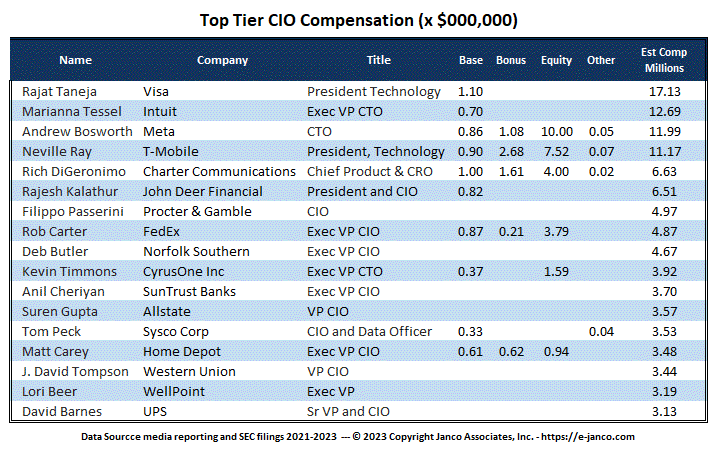
How should a CIO be compensated?
When
CIOs start to think about compensation for their staffs, they need to consider
their own compensation. Some of the
questions that they should ask themselves are:


-
What are the basics of the annual wage package for CIOs of other
companies?
-
What is the preferred method for manifesting the compensation package
into a time specific contract?
-
Which elements of the equity compensation are most favored by CIOs?
Why?
-
How
do CIOs value the different components of the compensation offer? What
emphasis is placed on bonuses? Stocks? Wages?
-
How
does the CIO package set the tone for the other compensation programs offered
to other Information Technology management team members?
-
What language is important when it comes to the compensation in the
employment contract?
-
What are the 5-7 most important components of the employment contract
to a CIO?
-
Which components are the most challenging to negotiate? Why?
-
Which components can be bargained away in favor of other, more
important contract terms?
-
What system is most effective when trying to update a CIO compensation
package?
-
What is the most common compensation structure for members of the
management team? Why?
-
What method is used to analyze the compensation structure for each
CIO?
-
What industry standards are applied to the compensation and employment
contracts?
-
What calculations and metrics are used to structure the CIO
compensation?
-
Which structural elements constitute the greatest amount of CIO
pay?
-
How
is performance measurements detailed in the employment contract and
compensation agreement?
-
Which Information Technology positions are most closely tied to
performance measurements? Why?
-
How
are complicated elements of the compensation plan analyzed and
monitored?
-
What procedure is used to peg compensation to other organization
goals?
-
What schedule is outlined for reviewing compensation against
performance goals?
-
Which incentive based elements of the package are preferred by CIOs?
-
Which elements of the employment contract are most important to CIOs?
Why?
-
What negotiating strategies and techniques are most
successful?
-
What are the most difficult terms to negotiate? What can the CIO do to
prepare for these hot topics?
-
What language must the CIO or CIO insist upon when it comes to the
employment agreement?
-
What are the non-financial aspects of the contract? Why are these
important to CIO level management?
-
What must CIOs be careful about when it comes to date specific terms of
the compensation and employment contract?
-
How
much time and money should a CIO budget for negotiating?
-
What is the impact of poor negotiations on CIO
performance?
-
When is it best to work through a third party?
-
What process is used to facilitate stalled
negotiations?
-
How
are CIO level employment contracts changing? Why?
-
What is the impact of these changes directly on the contracts? Which
trends do you expect to benefit the CIO?
-
What terms or issues can CIOs expect to deal with in the future, in
light of recent trends?
-
What techniques can management use to get a better compensation
package?
-
When does it make sense to go to the Board of Directors regarding pay?
Why?
-
Why
is it important for both parties to be satisfied with the contract? How is
this accomplished?
-
What methods are CIOs using to keep their contracts
progressive?
-
How
do the current tax laws influence changes to CIO employment
contracts?
-
What impact do corporate rules or policies have on the CIO
compensation?
-
Who
is most actively involved in developing company policies that impact
compensation? What is the trend?
-
What are the challenges to CIOs who are looking to improve their
package?
-
What is the current thinking companies regarding deferred compensation?
Why?
-
How
can the Board of Directors guide the employment contract
process?
-
What is the typical timeline for completing an agreement once the
process has started?
-
Who
is most instrumental in facilitating the negotiations? Why?
-
Which deadlines are most important in the employment
contract?
-
What are the biggest mistakes CIOs make when negotiating employment
contracts?
-
How
consistent are the agreements across members of the management
team?
-
When is it allowable to operate without an employment contract? What
are the risks?
more information
04/25/2008
Google Tags Morgan Stanley For its CIO
(CNET News.com) Google has found its new chief
information officer, a programmer who rose through the ranks to run much
of Morgan Stanley's computing infrastructure.
The new CIO was a managing director who led
the Morgan Stanley Application Infrastructure group.


According to an internal Morgan Stanley
memo, the new CIO will leave Morgan Stanley at the end of the month to
pursue opportunities outside the firm.
The memo also indicated that the new
CIO is no stranger to Google. While at Morgan Stanley, one of his projects
was working on initial public offering of Google in 2004, the memo.
The last CIO at Google, left to become
president of the EMI digital unit. Earlier this month, rumors surfaced
that Morgan Stanley executive would be the new Google new CIO.

Running the Google computing infrastructure is a daunting challenge on which
the companys success hinges. Google not only has thousands of servers housed in
at least 36 data centers scattered around the globe, but also a
build-it-yourself culture that means the company is responsible for maintaining
much of its own technology.
The CIO worked for Morgan Stanley computing
operations for nearly 14 years including having worked on first Morgan
Stanley Web site, its workstation software, and its
intranet.
more information
04/22/2008
H-1B visa program is not working
H-1B visa program is not working as it should be
based on the statistics that have been given to congress:


- 65,000 H-1B visas are issued each
year
- 3,117 H-1B visas were issued to Microsoft in
2006 and the average wage for those holders was $100,000 including
benefits.
- 19,000 H-1B visas were issued to companies based
in India in 2006
- $50,000 was the median compensation paid for
H-1B visa holders in 2006
more information
04/21/2008
Baby boomer retirements will impact IT
The U.S. Bureau of Labor Statistics says one
in four workers will be 55 or older. And particularly in IT, there is not a
big influx of new talent. According to the Computing Research Association,
computer science enrollments dropped 14% each year between 2004 and 2006.


Although IT organizations certainly understand
these workforce trends, many are not taking significant measures to mitigate the
risks that the loss of intellectual capital seems to portend. Even outside of
IT, many companies seem unconcerned by boomer retirements. In a 2006 survey of
488 companies only 42% of the respondents said that the aging workforce was a
significant issue, and 29% said it had little or no significance.
And in a nationwide study of 550 human resources
managers conducted by Monster.com last summer (view PDF), only 12% of the respondents said they consider knowledge
retention a high priority within their companies, even though one-third said
they expect at least 20% of their workforce to retire in the next
decade.
The inescapable conclusion seems to be that many
businesses are perfectly content to see their boomers walk out the door. And
because so few organizations have taken the retirement issue seriously,
companies that want to transfer knowledge from older to younger workers have few
models to follow. As a result, those that are attempting to get ahead of the
retirement wave are finding themselves pretty much on their
own.
more information
04/18/2008
AT&T Layoffs Will Impact 4,500
(IDG News Service) AT&T Inc. plans to lay off 1.5% of
its employees, primarily in management, in an effort to streamline its
operations, the company said today.
AT&T
had about 310,000 employees at the end of 2007, meaning the layoffs would affect
about 4,650 workers. The layoffs are the "next step" in streamlining company
operations in an effort to operate more efficiently after recent mergers between
parent company SBC, the old AT&T and BellSouth, the company said in a filing
with the U.S. Securities and Exchange
Commission.
AT&T expects its total number of employees to
remain stable in 2008 as the company hires additional employees to support
growth areas, AT&T said in the filing. In 2007, the company added about
7,000 employees, said an AT&T spokesman.
This initiative is part of the companys move from a
collection of regional companies to one AT&T focused on customers, AT&T
said in the filing.
The layoffs mean AT&T will take a
one-time charge of $374 million during the first quarter of 2008. AT&T is
scheduled to announce its first-quarter earnings Tuesday.
AT&T reported a net income of $3.1 billion for
the fourth quarter of 2007. It's revenue for the quarter was $30.3
billion.
more information
04/15/2008
IT Becoming a Male Bastion
(eWeek) While women hold
51 percent of professional jobs in the United States, they make up only 26
percent of the IT work force, according to the National Center for Women &
Information Technology. Furthermore, fewer women worked in IT in 2008 than in
2000.

But the loss of women in the technology field
begins long before they reach the professional level. The proportion of CS
(computer science) bachelor's degrees awarded to women has fallen from 36 to 21
percent between 1983 and 2006.
Dr. Stephen Bloch, a professor in the Department of
Math and Computer Science at Adelphi University in Garden City, New York,
told eWEEK that computer science degree enrollments have been in the toilet
since 2001.
more information
04/14/2008
What CIOs and CTOs need to do in order to succeed
CIOs and CTOs need to be part of the
executive management team in order to succeed. They must:

-
CIOs and CTOs must be
trusted contributor to executive thinking. CIOs and CTOs who
perform well establish a strong connection with executive management and are
key providers of insights to the executive team about new business
opportunities, ways to speed up product introduction, or other potential
technology-enabled business changes.
-
CIOs and CTOs must propose new
solutions to solve business problems. CIOs and CTOs that are in
tune with business unit issues surface opportunities and direct their staff to
solve business problems, like paper-intensive sales lead handling or
cumbersome manufacturing processes.
-
CIOs and CTOs must hire,
retain, and develop a loyal staff. Some IT execs describe high
job satisfaction and very low turnover in IT, even for highly marketable
skills. Why? Because career and employee development is a priority of the CIO
who makes the time for his or her team.
-
CIOs and CTOs must take time
to learn and test ideas. CIOs
and CTOs are the thought leaders in their firms about the business uses of
technology and the primary guide of IT strategic thinking. CIOs and CTOs who
pause to learn from others and reflect will find that new ideas and a
refreshed perspective keep the job fresh and their organizations
energized.
more information
04/14/2008
Private sector pay should keep rising
(Reuters) -- U.S. private sector wage
growth should continue to accelerate in the months ahead on the back of a
healthy employment climate, according to a survey released Tuesday.
The Bureau of National Affairs Inc., a
Washington, D.C.-based news publisher, said its revised third-quarter Wage Trend
Indicator rose to 100.86 from the final second-quarter index of 100.72. BNA put
the initial third-quarter reading at 100.92.
"We expect year-over-year wage increases
to continue to accelerate modestly, even though the pace of job growth has
slowed recently," said economist Kathryn Kobe, who worked on the development of
the index for BNA.
The indicator recorded its ninth straight
quarterly increase for the first time since 1996-1998, BNA said.
A sustained increase in the indicator
generally foreshadows increased pressure for higher wages, BNA
said.
more information
04/13/2008
Signs That Your Job is at Risk
Your
job may be at risk when:
-
There is a new CIO or manager whom you report to that you do
not have a prior relationship with
-
Your
company has new ownership
-
You
have been asked to re-apply for your existing
job
-
Your
desk has been moved to an out of the way location or your office size has been
decreased
-
You
are directed to do everything in writing
-
You
are not invited to team meetings
-
You
are not given sufficient resources to achieve your
goals
-
Your
company is trying to hire someone that could fill your existing
position
-
You
now have less responsibility
-
You
are no longer popular with your
peers
more information
04/01/2008
Dell to Eliminate 3,200 Jobs
Dell Inc., the world's second largest PC vendor,
plans to cut costs by $3 billion as it slashes the price of materials and
components going into its gadgets and reduces operating expenses, including
5,600 jobs in addition to the 3,200 it has already eliminated.

As part of its cost-cutting measures, Dell plans to
close a desktop-PC manufacturing plant in Austin. A massive shift in customer
preference for notebooks over the past three years was also a major factor in
the decision to close the plant, said a Dell executive.
The company has already reduced its workforce by
3,200 people and plans to cut around 5,600 more jobs.
more information
03/28/2008
H1-B Visa Battle Rages
(Computerworld) WASHINGTON — Stymied so far in
their efforts to get Congress to allow more skilled foreign workers into the
U.S., H-1B visa supporters are asking the Bush administration to extend the time
that foreign graduates of U.S. universities can work on student visas from one
year to 29 months.
The proposed extension is a stop-gap plan that wouldn't increase
the federal government's cap on the number of H-1B visas that can be issued each
year. But it would buy extra time for foreign students who graduate from college
in the U.S. this year.
A foreign student needs a degree to qualify for an
H-1B visa, but seniors who are graduating this spring won't have their degrees
before next Tuesday — the day that the U.S. Citizenship and Immigration Services
will begin accepting H-1B petitions for the government's 2009 fiscal year.
The USCIS may get more than enough applications for
all of the available visas — 85,000 all told, including 20,000 set aside for
people who hold advanced degrees from U.S. universities — on April 1 alone. That
means upcoming graduates likely will have to wait until next year to apply. And
if they didn't succeed then in getting H-1B visas through the government's
random lottery process, they could be forced to leave the U.S. under current
student-visa rules.
Proponents of changing those rules say that
increasing the amount of time a foreign graduate could work in the U.S., under a
program referred to as Optional Practical Training, would give students a better
chance of getting H-1B visas. In addition, the proposed change could be made
administratively, without any legislative action. Supporters of the idea have
been urging the U.S. Department of Homeland
Security, which oversees the USCIS, to approve
the extension.
more information
03/25/2008
Six Steps to Take if you are Laid off
You are laid off – Now what
1. Go to the Human Resource
department they can tell you what the company is offering your
2. Understand what Benefits
you are entitled to
3. Know what monies you are
due for the time up to your getting a pink slipe
4. Understand what rights you
have
a. Review your
employment agreement if you have one
b. If there is a union see
what are entitled to
c. Review your original
offer letter
d. Know what the formal
policies of the company are as part of the ERISA for pension and health plans
5. Understand how severance
does and does not work
6. If you are asked to sign a
release know what rights you are signing away
more information
03/24/2008
What are the ways you can scuttle your career
Nine sure ways to scuttle your
career are:
-
Have a chip on your shoulder
-
Decide for yourself what is important
-
Protect yourself and your associates at the expense of your
employer
-
Have a 9 to 5 attitude
-
Issue ultimatums
-
Do
not acknowledge when you are wrong
-
Burn your bridges
-
Do
not listen to others
-
Have a closed mind to new approaches and
technologies
more information
03/20/2008
H-1B Rules Set For Lottery
The
USCIS will hold a lottery, similar to what it did last year, if it receives more
than 65,000 visa applications under the H-1B cap. An additional 20,000 visas
will be available for foreign nationals who receive advanced degrees from U.S.
universities. The government will begin accepting visas on April 1 for the 2009
fiscal year that begins Oct. 1.
Under the rule, the USCIS will prohibit companies
from filing multiple H-1B petitions for the same employee. These changes will
ensure that companies filing H-1B petitions subject to congressionally mandated
numerical limits have an equal chance to employ an H-1B worker, the agency said
in a statement.
If caught, prospective employers
risk having all of their petitions for H-1B visas denied or revoked. There is an
exception, however. The rule does not preclude related employers, such as a
parent company and its subsidiary, from filing petitions on behalf of the same
worker for different positions, based on a legitimate
need.
more information
03/18/2008
Research Finds MBA Nearly Doubles Salary Outlook for IT
Robert H Smith School of Business - U of Maryland - Firms in the
United States value IT professionals MBA degrees much more than IT experience,
according to new research. An IT professional with an MBA degree earns 46
percent more than a counterpart with only a bachelors degree and 37 percent more
than one with any other masters degree, according to the study, published in the
Management Science journal.
University of Maryland research confirms that getting an MBA
is the single best move you can make to increase your value as an IT
professional in todays market, said the assistant professor of decision,
operations and information technologies and lead author of the study. Education
is more valuable than experience because it provides more durable and versatile
conceptual skills. In contrast, IT experience has high rate of obsolescence —
learning new technologies only makes a professional valuable for a few years
when those skills are in high demand. An MBA education teaches how to evaluate
new technologies or how to strategically invest in and manage IT projects, which
makes for a more valuable long-term employee that can use those skills in a
variety of situations.
On average, in dollar terms (deflated to 1999
figures), IT professionals with MBAs earn more than $24,000 per year than those
with only bachelorÂ’s degrees and more than $17,000 per year than those with
other masterÂ’s degrees after controlling for a variety of demographic and
institutional factors.
more information
03/17/2008
Only 31.4% of All CIOs report to the CEO
According to a survey by the SIM only 31.4%
of all CIOs who are members of SIM report to the Chief Executive Officer.
The s
|