
Enterprises have an enterprise wide security
policy;
Enterprises have enterprise wide
classification of data for security, risk, and business impact;
Enterprises have security related standards
and procedures;
Enterprises have formal security based
documentation, auditing, and testing in place;
Enterprise enforce separation of duties; and
Enterprises have policies and procedures in
place for Change Management, Help Desk, Service Requests, and changes to
applications, policies, and procedures.
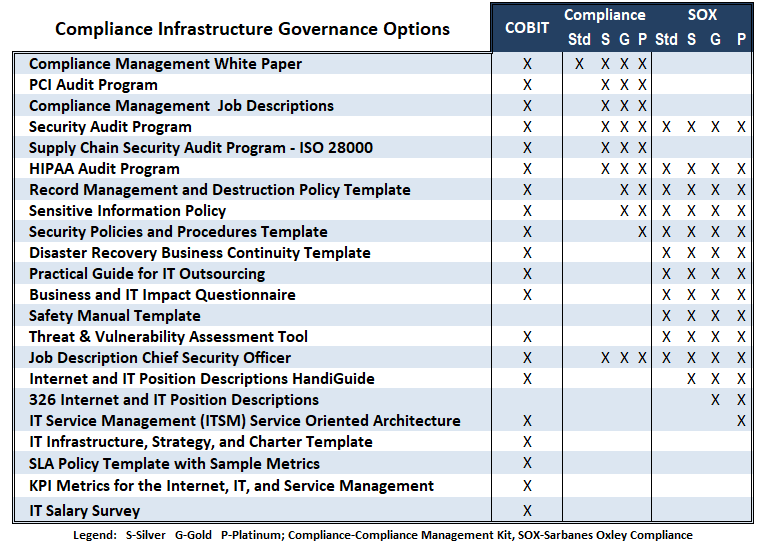
To meet these needs the Sarbanes Oxley
Compliance Resource Kit, which comes in four editions (Standard, Silver, Gold,
and Platinum) contains:
Business & IT Impact Questionnaire Risk
Assessment Tool (all editions);
Safety Program Template (all editions);
Disaster Recovery Template (all editions);
Outsourcing guide update to reflect what you
vendors need to do (all editions);
Software tool to monitor key data files (all
editions);
Internet and IT Job Descriptions (Silver,
Gold, and Platinum Editions) and;
IT Service Management Template (Platinum
Edition).
Security Manual
The plan is 178 pages and includes
everything needed to customize the Internet and Information Technology
Security Manual to fit your specific
requirement. The electronic document includes proven written text and
examples for your security plan. View
The Table of Contents And A Few Pages
Disaster Recovery Plan (DRP)
This Disaster Recovery Plan (DRP) can
be used as a template for any enterprise. DRP is sent to you via e-mail in WORD
and/or PDF format. Included is a 13 page Business Impact Questionnaire
as well as a 3 page Job Description for the Disaster Recovery Manager. View a the Table of Contents and sample pages [Adobe PDF]
IT Job Descriptions
The 220 Internet and IT Position
Descriptions are in Word for Windows format. Includes positions
from CIO and CTO to Wireless and Metrics Managers.
View The Table
of Contents And A Few Pages
The
IT Service Management Template
The IT Service Management Template contains policies, standards, procedures
and metrics for Change Control, Help Desk and Service
Request processing. ITSM template also contains
several easy to implement forms and conforms
with ITIL. View The Table
of Contents And A Few Pages
Safety Program is 60 pages and includes
everything needed to customize the Safety Program to fit your specific
requirement. The Safety was updated in December of 2004 and
reflects the latest issues associated with the most recent
legislation (Sarbanes Oxley).
Minimun and Standard Power Protection for Workstations for DRP and BCP
Personal computers and remote servers often are damaged by
subtle anomalies that users never see, such as sags, surges, spikes, brownouts,
line noise, frequency variation, switching transients and harmonic distortion. A
business on typical utility power is subjected to these hidden power problems
every day and complete outages several times a year. Solutions that you should
implement for all such equipment include:
Minimum -
Surge suppressors address the power surges, but have no effect on the
under-voltage and variance conditions that can erode equipment health over
time or zap it in an instant.
Standard -
Uninterruptible Power Systems (UPSs) protect your IT systems by conditioning
incoming power to smooth out the sags and spikes that are all too common on
the grid and other primary sources of power Providing ride-through power to
cover for sags or short-term outages (30 – 60 minutes,
typically).
-
more Disaster planning, emergency preparedness, or business continuity
Disaster
planning, emergency
preparedness, or business
continuity (and experts note that there are differences) -the goals are ultimately the same:to get an organization back up and
running in the event of an interruption.The problem causing the interruption could be one computer crashing or an
entire network crashing.Or it
could be an electrical outage or the result of a terrorist activity.The goal is to have some contingency
plans in the event of a problem.A
disaster recovery plan exists to preserve the organization so that it can
continue to offer its services.
A
disaster recovery plan is a users' guide - the documentation - for how to
preserve an organization.In order
for a plan to be useful, it must be created before an interruption occurs.Business continuity is disaster
recovery.Lost revenue is a driving
force in business continuity.The
reason to do a recovery plan is essentially to keep the funding coming in and
the services going, and the clients being served.
Emergency
planningare those procedures and steps done immediately after an
interruption to business.
Disaster
recoveryare the steps taken to restore some functions so that
some level of services can be offered.
Business
continuityis restoration planning, completing the full circle to
get your organization back to where it was before an
interruption.
In
order to write your plan, you have to do some planning. This planning is the
process that will get you to the step where you then commit your plan to paper -
you canÂ’t write a plan until you do the preparation.The most difficult thing is getting
started; the second most difficult task is keeping the plan
current.
-
more The Difference Between Disaster Recovery Planning and Business Continuity Planning Defined
Disaster
Recovery Planning (DRP) is the process by which you resume business
after a disruptive event.This
typically means that you can get the enterprise computers, networks, and data
base operational. The event might be something huge-like an earthquake or the
terrorist attacks on the World Trade Center-or something small, like
malfunctioning software caused by a computer virus.
Given the
human tendency to look on the bright side, many business executives are prone to
ignoring "disaster recovery" because disaster seems an unlikely event. However
Janco has found that over one third of all enterprises have had to activate
their Disaster Plans in the last few years.
Business Continuity
Planning (BCP) suggests a more comprehensive approach to making sure you can
keep the enterprise going and meet it business objectives. This goes beyond the
enterprise computers, networks and data bases.However, the two terms are married under
the acronym DR/BC or DRP/BCP. At any rate, Disaster Recovery Planning and/or
Business Continuity Planning facilitate how a company will keep functioning
after a disruptive event until its normal facilities are
restored.
-
more Disaster Recovery Business Continuity Scope
Conduct a business impact
assessment. This involved a crossfunctional team to evaluate the
business requirements and tier data based on the importance to our business
operations.
Protect data and
applications. It was important to back up data frequently to
ensure records are kept, so we needed to upgrade our backup equipment to a
faster version to reduce the time it took to complete a backup cycle.
Review power and
connectivity options. We needed to add uninterrupted power
supplies (UPS) and connectivity for critical servers, network connections and
selected personal computers to keep the most essential applications running in
case of a power outage.
Document, test and update the
disaster preparedness plan. Part of the Janco Disaster Recovery
and Business Continuity Template plan needs you to include updated
configuration diagrams of the hardware, software and network components to be
used in the recovery. The plan also needed to include logistical details, such
as travel to backup sites and spending authorization for emergency
needs.
Consider
telecommunications alternatives. Often taken for granted,
telecommunications backup involving redundancy and alternatives needed to be
in place - and in the case of spot outages, redundancy may be enough. For
larger outages, alternative communications vehicles, including wireless
phones, wireless data cards and satellite phones, had to be
considered.
-
more Testing is Critical to Disaster Recovery Planning
All good disaster recovery
and contingency plans start with having a good solid backup of data.
Although systems and applications can be reinstalled and reconfigured, data
cannot be rebuilt out of thin air. The key to having a good backup is to make
sure the data is correct and can be successfully restored. This is not always as
easy as it seems. One company had such an issue. Their backup administrator did
not correctly follow procedures and when he thought he was doing a backup, he
actually was not writing anything. When they tried to restore a database, they
found out all the tapes were blank.
-
more Cost of Disaster Recovery Backup Is High For Many Enterprises The
need for de-duplication is increasing for many organizations as they gather
ever-growing volumes of data. At the same time, they are looking for ways to
reduce storage costs, improve efficiencies and provide adequate disaster
recovery capabilities. The key benefit is the ability to lessen the Total Cost
of Ownership (TCO) of storage hardware by eliminating redundant blocks of data
and then allowing organizations to replicate that data -- if required -- to a
second system for offsite storage. That can remove the need for tape. Data
de-duplication not only allows companies to reduce the disk space needed for
backup and restore, but it can increase performance and reliability while
reducing demands for rack space, power and cooling. Further, it can reduce the
bandwidth requirements for data transfer by 90 percent or
more.
-
more Pandemic Alert Level 5 Requires DRP/BCP Plans be Activated
The World Health Organization has raised the
pandemic alert over the spread of swine flu to phase 5.
WHO says that based on assessment of all available
information and following several expert consultations raised the current level
of influenza pandemic alert from phase 4 to 5.
While making the annoucement, WHO stated that all
countries should immediately activate their pandemic
preparedness plans. At this stage, effective and essential measures include
heightened surveillance, early detection and treatment of cases, and infection
control in all health facilities.
In disaster planning when a
pandemic occurs the data center exists but people are in separate locations.
The Disaster Planning and
Business Continuity Planning processes need to make the user and business
operating experience as similar as possible so that the work environment is the
same in the remote site (often home) as in the office. A key requirement is to
increase remote access capabilities in addition before the pandemic occurs the
following planning needs to take place:
Define necessary staff levels for critical
business processes
Identify who can work remotely and who has to be
in the office
Validation of vaccinations for key staff members
Identify the lights out processing issues for
computer operations staff
Identify the network and remote access capacity
requirements - what percent of workers do you need to be on the system for the
enterprise to continue to operate
Train and test of users and IT staffs in how to
operate from remote locations Require key employees to work from remote site
at least once a month
Validate broadband capacity to remote sites
(home users)
Have copies of disaster plan available in remote
site
Put in place process for the synchronization of
OS system patches and VPN updates - if the workstations are not used
frequently disable the auto update features for security updates but maintain
a process to see that they workstations are up-to-date.
Define specific requirements for security and
PCI-DSS when the disaster plan is activated for a pandemic.
Define change management and version control
processes to be used and how they will be controlled during the
pandemic.
-
more How to get started with a Disaster Planning process
Getting started with a disaster
recovery / business continuity plan may seem daunting, but is not. The process
starts by addressing the needs of the business - not the IT department.
Access the enterprise's
operating environment- Identify critical business functions
and then determine which systems, applications and data must be available to
keep each function running smoothly.
Conduct an IT business impact
analysis- Develop a hierarchy of business functions and
processes based on their importance to operations. You will most likely find
that, although some systems need to be up and running as soon as possible
after a disaster, other systems can wait.
Establish a team with
enterprise wide management experience and responsibility-
Gather representatives from across the business, from IT to human
resources and facilities management. Each member should contribute to both the
development of the disaster recovery plan and its execution. Be sure to define
their responsibilities and the reporting hierarchy in the event of a disaster
and to equip them with mobile technology, so they can make decisions
spontaneously.
Develop budgets and funding
sources- A disaster recovery plan is only as effective
as the resources that are committed to it. Once you have determined what it
will require to support your business recovery objectives, you need to
identify the tools and procedures needed to meet them. Be specific about the
cost of these mechanisms, as well as the financial risk of disaster, so you
can build a realistic business case.
Define specific responsibilities
and tasks - Spell out
tasks, responsibilities and roles - not only to revive systems, but also to
provide access to users and enable operations to continue even under
compromised circumstances.
Re-evaluate what has been
created and keep it up to date - Test it, reexamine it and update it
regularly - once a year, twice a year or even quarterly. Also, remember that
there are continuing advancements in disaster recovery technology. Keep
revisiting your options to take advantage of faster, more-cost-effective
solutions.
-
more Google Designs its Servers With DRP and BCP in Mind
Most
companies buy servers from the likes of Dell, Hewlett-Packard, IBM, or Sun
Microsystems. But Google, which has hundreds of thousands of servers and
considers running them part of its core expertise, designs and builds its own. Google has
designed its own servers and each server has its own 12-volt battery to supply
power if there's a problem with the main source of electricity. Since 2005
Google's data centers have been composed of standard shipping containers--each
with 1,160 servers and a power consumption that can reach 250
kilowatts.
A disaster
or business interruption occurs, what do you do?A quick roadmap to follow
is:
Do not
panic and remain calm! When a disaster or business interruption occurs the
first priority number is to ensure the safety of the employees.
Evaluate the disaster! Determine the impact on your personnel
and enterprise operations, this evaluation the event is critical in making the
decision to activate the disaster recovery business continuity procedures.
Communicate with everyone that can be impacted! Communicate with
your team, managers, affiliates, and vendors frequently. Even if there is no
status to report, do not leave anyone guessing or letting them draw their own
conclusions.
Know
the disaster recovery
business continuity plan! Testing the Business Continuity Plan regularly
helps everyone in becoming familiar with what will happen and how it will be
done.
Be
decisive! Once you have determined the level of disaster and everyone is safe
to operate, it is time to make the decision if you need to implement the
business continuity procedures or if the downtime for recovery acceptable.
Start
the process! Start with recovering the most business critical systems first to
restore business operations to a functional level. There should not be any
question, which order which applications need to be restored first.
Lock
down all backups and critical documentation! The first step to the recovery is
having a set of data to recover from. This could be anything from archived
tape, local disk copy, and a co-location or disaster recovery data center.
Use multiple solution paths! Assume that nothing will work and
have alternatives in place
Reactivate normal operations! Once the systems are operational,
the disaster is over and systems are repaired it is time to move the workloads
back to where they were originally.
-
more Disaster Recovery Business Continuity in a Mixed Vendor Environment
How do you create a unified Disaster Recovery Business
Continuity Plan when you IT services are outsourced to multiple vendors
and some of their facilities are in the same geographical area?Some vendors are now starting to offer
services that are designed to help enterprises get a converged view with which
to manage and monitor their entire IT infrastructures,
regardless of whether services are delivered by in-house resources or by third-party service
providers.
These service providers recognize that
enterprises are moving services to specialty vendors such as security providers,
network providers or computing services providers, rather than to a single
services provider.
Popular social networking site
Facebook.com admitted on a blog post today that over the weekend, a hard drive
failure led to the temporary loss of 10% to 15% of its users stored
photographs.
According to the company, several drives failed at
once during a routine upgrade Friday night.
"You may have noticed in the past day that some
photos aren't appearing or are displaying a 'question mark' graphic when you go
to view them. We're trying to fully understand what happened, since simultaneous
hardware failures like this are rare," a Facebook engineer, stated in his
blog.
Facebook said its users' photos are safe because it
stores multiple copies of the data for disaster recovery and business continuity
purposes, and it is working to make the photos affected by the system failure
available again as soon as possible.
A hard disk drive duplicator has been released. The second
generation device is a compact and portable cloning solution with blazing
cloning speeds approaching 6GB/min! A full color touch screen provides an easy
to use interface, and support for SATA/IDE/USB/Firewire 1394B makes the device
an extremely versatile duplicator.
The hand-held unit provides the convenience of on-site as well as
"on the bench" cloning. Novice users will appreciate the "wizard" function that
steps them through key cloning operations. Advanced software including Clever
Copy, Selective Partitions and Master Manager is included with the device. The
compact, feature-rich cloning device also features support for verification of
the cloned drive using an MD5 signature of target drive. The SuperSonix device
is Windows Vista compatible and supports e-SATA and microSATA drives (with
optional cables) as well as solid state
drives.
-
more Disaster and Business Continuity Preparedness
IT managers must make disaster planning a top priority if
they are to prevent data loss and maintain business continuity in times of
crisis. Unfortunately, day-to-day operations too often steal the time that IT
professionals should otherwise devote to critical disaster planning and business
continuity efforts. Enterprises cannot prepare for yesterday's disaster today.
That is why you need Janco's Disaster Recovery and Business Continuity Template.
This comprehensive disaster and business continuity
preparedness template includes:
Plan Introduction
Business Impact Analysis -
including a sample impact matrix
DRP Organization
Responsibilities pre and post disaster - drp checklist
Backup Strategy for Data
Centers, Departmental File Servers, Wireless Network servers, Data at
Outsourced Sites, Desktops (In office and "at home"), Laptops and PDA's.
Recovery Strategy including
approach, escalation plan process and decision points
Disaster Recovery Procedures in a check list
format
Plan Administration Process
Technical Appendix including
definition of necessary phone numbers and contact points
Job Description for Disaster Recovery
Manager (3 pages long) - entire disaster recovery team job
descriptions are available.
Work Plan to modify and
implement the template. Included is a list of deliverables for each
task. (Risk Assessment and Vulnerability Assessment)