
JancoJanco Forum

News Feed

Feed
Description

Janco Mobile Pages

Join Now

Home
Search
Templates
Salary Survey
HandiGuides
Job Descriptions
Individual Policies
Compliance Tools
White Papers
Update Service
Bundles & Special Offers
Software
Promotions

ITSM - Change Control, Help Desk, and Service Request

Sarbanes-Oxley Tools

Browser White PaperBrowser and OS Market Share White Paper

Firefox - IE - Opera - Mozilla - Safari - Google Desktop


    Download Selected Pages
 

April 2008 White Paper

The Browser Market Share and Operating System Market Share White Paper data is by month starting in September 1997 through the March 2008 

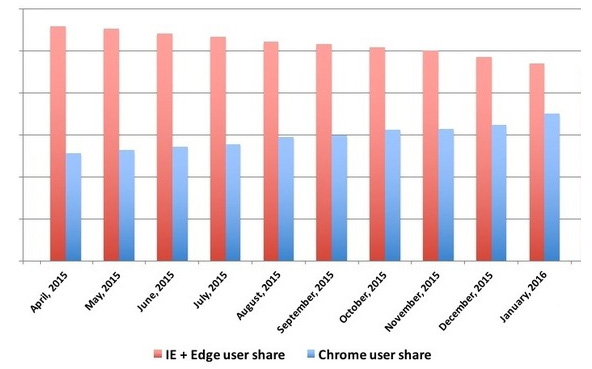
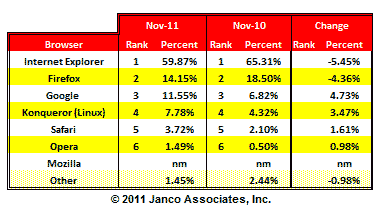
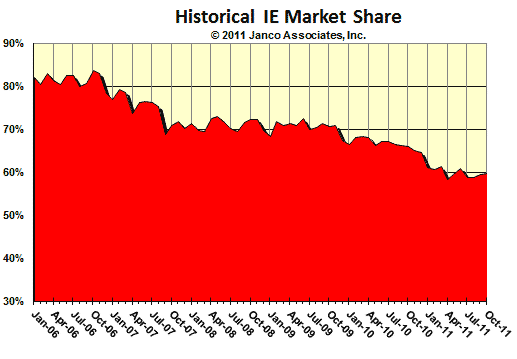
Microsoft has lost almost 9% of the browser market in the last 12 months.  Looking at the last 12 months, you can easily draw the conclusion that Firefox and Google Desktop are edging away at the Microsoft browser monopoly.  As Vista is rolled out to more users it will be interesting to see what that will do to the browser market.  So far user acceptance of Vista has been slowed by the lack if user acceptance for the new OS.

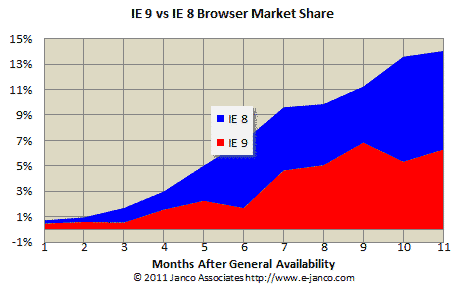
Live update did not help in accelerating the acceptance of IE 7, plus with the slow acceptance of Vista individuals and enterprises are not moving to the new version as rapidly as Microsoft would like.  An added kicker is those who move to Vista can more readily have multiple browsers on their systems or switch from one to the other quickly and with little pain.  The cost of doing that is minimal.

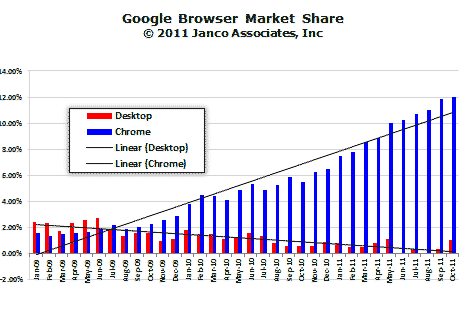
Google Desktop will be the next challenge for Microsoft to face.

The integrated tab feature is one of the greatest improvements in IE.  Based on our test results IE 7 is significantly more robust than prior versions.

Microsoft market share history


    Download Selected Pages


Trends in Browser OS Market Share 12 Months - March 2008 - March 2007


Mar-08

Mar-07

Change

Browser

 Rank

Percent

Rank

Percent

Rank

Percent

Internet Explorer

1

60.00%

1

68.63%

0

-8.63%

Firefox

2

19.95%

2

15.11%

0

4.83%

Netscape

3

9.68%

3

11.02%

0

-1.34%

Google Desktop

4

4.01%

6

1.51%

2

2.49%

Safari

5

1.65%

4

0.87%

-1

0.78%

Opera

6

1.17%

7

1.29%

1

-0.12%

Mozilla

7

1.32%

5

0.90%

-2

0.41%


97.77%


99.34%


The full study was produced with data through January 2008.  See a full copy of the  press release here.


Current News


Is Verizon Trying to By Pass the Open WiFi Rules of the FCC?

(eWeek) Google is challenging Verizon's vision of what sort of open network it will run on the spectrum it recently acquired in the Federal Communications Commission auction for $4.7 billion. Under the auction rules, Verizon is required to build an open network to which users can connect any legal device and run the software of their choice.

Sarbanes Oxley Compliance    IT Job Descriptions

But in a May 2 filing with the FCC, Google contends Verizon has no such intentions. Instead, Google claims, Verizon plans to institute a two-door policy: one door for open access devices and applications and another door for closed devices that only support Verizon's proprietary applications.

Metrics Internet and ITPolicy Sensitive InformationBlog Policy

In the filing, Google urged the FCC to deny Verizon a license to use the spectrum until it fully commits to an open network.

Salary Survey 2006   CIO Productivity Kit IT Infrastructure, Strategy, and Charter Template

Verizon has taken the public position that it may exclude its handsets from the open access condition, Google states in the filing. Verizon believes it may force customers who want to access the open platform using a device not purchased from Verizon to go through Door No. 1, while allowing customers who obtain their device from Verizon access through Door No. 2.

It is door No. 2 that troubles Google, which is heavily invested in promoting its own Android open-source mobile platform. As the search giant sees it, Verizon plans to deny Verizon customers full open access to competing devices and applications.

Accourding to Google, the FCCmandates opening the C Block network for the use of any device, and for the use of any application on any device, regardless of whether an end user obtains the device from the licensee, another service provider, a manufacturer or other third party.

Verizon promptly dismissed the Google concerns.

The Google  filing has no legal basis.  It is really no surprise that despite not winning spectrum, they continue to try to change the rules and further their own business interests through the regulatory process, Verizon spokesman said in a statement, adding that Verizon plans an FCC filing in next several days to counter the Google claims.  

Last summer, Google lobbied the FCC into adopting open access standards for the prime C Block of spectrum, a notion Verizon initially opposed in a lawsuit, contending that the spectrum should go the highest bidder with no restrictions. Verizon eventually dropped the legal challenge.

Verizon Wireless Â… understood the FCC rules for using that spectrum in advance of the auction, a Verizon spokesman said. Of course Verizon will abide by those rules.  As Verizon works to put the spectrum we won to good use, if Google or anybody else has evidence that we aren't playing by the rules, there are legitimate and expedited ways to address that.

 
more info 


iPhone to be Discounted by AT&T

(Business Week) Published reports that first appeared on the Web site of Fortune Magazine suggest that AT&T (T), which has an exclusive five-year deal to sell the iPhone in the U.S., is prepared to subsidize the device by as much as $200, slicing the purchase price as low as $199 for customers who sign a two-year service contract. Apple and AT&T declined to comment on the matter.

Metrics

Such a discount could cause a surge in demand. At last count, Apple had sold some 5.4 million units, the vast majority of them for AT&Ts network, even with price tags of $400 to $600—essentially unheard of in the U.S. cellular market. Impressively, AT&T says 40% of its iPhone users are new customers. Yet with rival smartphones like Research In Motion's (RIMM) BlackBerry and a new Palm (PALM) Treo selling for as little at $99 at some carriers, competitive pressures are building.

But a price cut might be about more than nabbing new customers. AT&Ts goal may also be to boost monthly revenues from existing subscribers who switch to the iPhone, as the big colorful screen and robust Web browser on the Apple device tends to make iPhone owners heavier users of AT&Ts wireless data services. AT&T brings in about $90 a month from each iPhone user, reckons an analyst with UBS Investment Research (UBS). When Apple cut the price on the iPhone by 33% earlier this year, it stimulated demand, he says. If this new price turns out to be true, it would do it again. It's like déjà vu all over again.

For AT&T, eager to generate returns on its multibillion-dollar investments in a next-generation data network, a $200 subsidy on a device with a proven success record may be a no-brainer. This is not unexpected at all. The $200 is a small fraction of the revenue that AT&T makes over a two-year contract.

 
more info 


IT Productivity Center Electronic Newsletter May 2008 Released

The IT Productivity Center has just realeased it May 2008 electronic newsletter.  The newletter can be obtained by going to http://www.itproductivity.org/IT_Productivity_Newsletter_20080501.htm.

The topics covered in this issue are:

  • IT Service Management (ITSM) is impacted by the recession
  • Technology Investments Approaching the Point of Diminishing Returns
  • Productivity Tools

In addition the newletter has links to:

  • Metrics HandiGuide
  • ITSM Template
  • CIO Productivity Toolkit
  • IT Job Descriptions
  • 2008 Salary Survey
 
more info 


Career suicide - Things to Avoid Doing

Career suicide can happen all too easily, in several different ways. Fortunately, by taking common-sense steps, you can reduce its chances of happening. Things that you do not want to do if you want to succeed:

Salary Survey 2006   CIO Productivity Kit IT Infrastructure, Strategy, and Charter Template


Security Manual Template - Sarbanes-OxleyIT Hiring Resource KitSecurity Audit Program

  • Sending e-mail without thinking about the consequences - Most of us are bright enough to realize that chain letters or off-color jokes have no place in business communications. Where most office workers get into trouble is with the over-hasty e-mail reply. Ever read an e-mail too quickly and fired off an angry reply, only to discover later that you had misinterpreted the first sender's message? You end up not only wasting everyone's time, but poisoning your work relationships -- perhaps permanently.
  • Say negative or uncomplimentary things about  co-workers - Having done a significant amount of work for a particular client, I decided one day to try to expand my presence there. I called an executive in another part of that organization, introduced myself and said that "Carl” was pleased with my work. That executive responded, "Why should I care what Carl thinks?"

    Not smart -- especially when said to someone outside the organization. If Carl had heard about this remark (and these things do get around) it could have created a Grand Canyon-size rift between him and his indiscreet co-worker. More critically, remarks like this damage the credibility of the organization.
  • Contradicting your boss or management publicly - Suppose that your boss, while giving a presentation, makes a factual error. Should you jump in and correct the error immediately, secure in the knowledge that your boss will thank you for underlining the mistake in front of an entire room of people?

    Correcting your boss in public will hardly endear you to him. More likely, he will be upset at being made to look foolish, and may even wonder why you didn't catch the error yourself prior to the presentation.
  • Committing social blunders at a company event - Staff misbehavior at office parties has been a cliché since the 1950s, but that does not mean people still do not make fools of themselves. Such functions are not purely social events. Do not do anything you would not do at the office or at a client's office.
  • Burning bridges when you resign - Many of us fantasize about telling off the boss when we quit a job. Remember the 1990s Internet bubble? Many IT people left traditional companies with visions of pulling in millions from Internet start-ups, only to be rudely surprised when their new companies went under. Those who left on good terms with their former employers had a better chance of being rehired.
 
more info 


Steps to protect your critical data

Security Manual Template

There are a number of steps that your company can follow to minimize the exposure to the security breaches.  These include:

  • Security Audit ProgramMonitor financial databases directly
  • Test access to databases and fix all weakness found
  • Audit user access
  • Limit downloading of more than 5% of the data to a single source and validate the destruction of that data within a reasonable period of time
  • Validate if the way users use the data to see that it complies with company policies
  • Validate transactions are authentic
  • Conduct an audit with independent auditors
  • Automate the system of internal controls with a clear audit trail that is reviewed in real time
  • Encrypt data

Network Event Viewer - Security Event ViewerSMART Disk Monitor

 
more info 


Downtime versus data saved is the issue

Disaster Recovery Planning Template(Blue Coat) The global enterprise has a voracious appetite for data, and little patience for downtime. According to a recent Forrester report, 82 percent of larger IT organizations rated improving recovery time as a “critical” or “very critical” business priority.


The need for continued focus and investment is clear, especially when you consider that data-at-rest in enterprises is growing at a compounded rate of 55 percent a year.


Disaster Recovery Audit Progam


Moving all that data is a mounting challenge, and business simply cannot wait.


To meet these growing demands at a reasonable cost, organizations are moving to IP-based networks; 70 percent of North American and 79 percent of European organizations use some combination of the Internet, MPLS or Ethernet to connect to their primary backup datacenter. Bandwidth prices may be in decline, but that doesnÂ’t mean it comes cheap. Bandwidth, on average, is 29 percent of the total cost of replication, backup and recovery solutions, and is often constrained by the effects of latency.


Security Manual Template - Sarbanes-OxleyIT Hiring Resource KitSecurity Audit Program


End-to-end plans for turning disaster recovery into full business continuity are very complex, but from an IP-network perspective it can be reduced to three main challenges.


The first is to accomplish backups in a timely yet accurate manner. Given organic data growth, and that each logical data object has between four and eight copies somewhere in the network, even differential backups can be tough to fit into assigned windows. Synchronous or live-to-live data models are even more bandwidth intensive and latency intolerant.


The second challenge is minimizing downtime. In the event of a failure or disaster, how quickly can backed-up data be restored? Considering a differential backup can take 8 hours or more to complete, and only represents 10-20 percent of the total data set, a full restore can be daunting. According to Ziff Davis Research, the average organization has 94TB of managed storage, and getting that data across the network only begins after the systems have been physically restored.


Finally, because of how long full data recovery can take, most organizations are moving from disaster recovery to disaster tolerance, where some level of service can be quickly restored in the name of business continuity. To do this effectively requires both warm – or even hot – standby servers and the ability to quickly re-route users, customers and partners to the secondary location. Beyond the clear routing and networking challenges, there are additional application performance concerns. Users may have to cross physically or logically longer networks with higher latency to reach the redundant datacenter, and do so over links whose bandwidth is typically provisioned as sparingly as possible.

 
more info 


Backups take too many resources for most enterprises

Data at rest is growing much faster than network throughput. That makes it difficult to get backups completed on time and on budget – not to mention trying to recover from an IT emergency.


The first is to accomplish backups in a timely yet accurate manner. Given organic data growth, and that each logical data object has between four and eight copies somewhere in the network, even differential backups can be tough to fit into assigned windows. Synchronous or live-to-live data models are even more bandwidth intensive and latency intolerant.


Backup Security


The second challenge is minimizing downtime. In the event of a failure or disaster, how quickly can backed-up data be restored? Considering a differential backup can take 8 hours or more to complete, and only represents 10-20 percent of the total data set, a full restore can be daunting. According to Ziff Davis Research, the average organization has 94TB of managed storage, and getting that data across the network only begins after the systems have been physically restored.


Compliance Software


Rather than add more bandwidth, or invest in expensive, dedicated storage networks, WAN optimization can improve IP network performance sufficient to turn recovery into continuity. To help meet the objectives outlined above, a WAN optimization solution must be able to do three separate tasks for true business continuity: restrict bandwidth to backup applications during the allowed window and allocate it to critical applications in the event of a disaster, overcome latency and bandwidth limitations on the wire, and provide acceleration to roaming or displaced users redirected to alternative data sources.

 
more info 


Internet will not be tax free much longer

(CNet) Two years ago, a CNET News.com special report found that 15 states and the District of Columbia said that their laws and regulations meant that digital downloads should be taxed. A few months later, New Jersey joined that list.

Since then, more states have become tax-inclined. In 2008 alone, Indiana, Utah, and South Dakota have enacted laws reiterating their commitments to collect taxes on digital downloads, while Nebraska recently voted to send its governor a bill (PDF) that would tax downloads of books, movies, and music starting October 1. Others, including Wisconsin and Massachusetts, have formed groups to study new iTunes taxes.

SLA - Service Level Agreement  SOX HIPAA ISO Compliance

I would not be surprised to see other states attempting to impose taxes on digital goods, said an attorney who represents a group of Fortune 500 digital goods vendors opposed to new taxes. He could not name the companies because irked tax administrators might retaliate by singling out his clients for audits.

One reason that music and movie downloads have partially escaped the notice of tax collectors is that, until a few years ago, the market was relatively small and state tax laws sometimes apply only to tangible goods. But their attitude has changed now that iTunes, Amazon.com, eMusic, Rhapsody, Wal-Mart Music, Yahoo Music Unlimited, and others have demonstrated that there is plenty of untapped revenue for tax-hungry politicians--underscored by reports like one in February stating that iTunes has sold more than 4 billion songs.

Threat Vulnerability Assessment - Sarbanes-Oxley Business IT Impact  Questionnaire - Sarbanes Oxley

Arguably the most heated showdown is looming in California, home to an $8 billion deficit and lawmakers who are scrambling to do something about it. The state legislature is considering a bill proposed earlier this year by Democratic Assemblyman, who represents a district east of Los Angeles. The bill calls for new taxes to sweep in digital property, which includes, but is not limited to, products like music, movies, and books.

Some opponents fear that broad definition could sweep up everything from electronic tax-preparation services to video games to advertising, causing new headaches for online retailers and their customers.

Backers of the new taxes--which, in the California case, include the AFL-CIO and associations that represent state, county, and municipal employees, teachers, firefighters, and county governments--contend they're necessary to offset budget deficits and to create parity with the physical versions of those products that would otherwise be taxed.

 
more info 


Help Desks are not performing well

According to a study conducted by Forrester Research, only 53 percent of surveyed IT users reported being satisfied with their help Help Deskdesk support. Areas such as resolving usersÂ’ requests in a timely manner and successfully resolving an issue on the first call were identified as key opportunities for improvement.

Do you want to know how your company can deliver exceptional support and, as a result, significantly impact your IT department and organization as a whole? Help Desk is the basis for IT Service Management and meeting the ITIL and ISO 20000 standards.  A good help desk will:

  • Quickly resolve technical problems and save time;
  • Rapidly resolve complex, mission-critical incidents; and
  • Handle increasing call volume without increasing budgets.
 
more info 


Sever versus no server in a wireless network

What is the difference in wireless networks with and without servers?  Is there a difference in the ease of implementation and operation?

Infrastructure

IT Service Management

Security


Wireless Network Options

No Server

Server

Best suited for small office/home office environments.

Smart choice for small to medium businesses, especially those with aggressive growth plans.

Relatively easy for a novice to set up.

Does not require significant technical knowledge to set up, but novices may need outside technical support/help desk.

Requires a wireless gateway or wireless router.

Requires one or more wireless gateways that support 802.11X network.

Does not provide centralized management of user accounts or user authentication.

Enables centralized management of user accounts and user authentication.

Provides limited methods to control or manage workgroup members.

Provides robust methods to manage domain member accounts. Controls can be fine-tuned.

 
more info 


IT Job Descriptions

Disaster Recovery Plan Template

Security Manual Template

Outsourcing Guide

IT Internet Metrics

Business IT Imapct SOX

News HTML
SAFE Shopping

© 2008 Janco Associates, Inc. - ALL RIGHTS RESERVED -- Revised: 05/02/08