
Facebook Follow


XLM News Janco News Feed

Reddit  Del.icio.us  Stumble Upon  Facebook  

Business Continuity &
Disaster Recovery Template
A disaster recovery is a response to a declared disaster or a regional disaster. It is the restoration or recovery of an entire Agent computer. A disaster recovery plan describes how an organization is to deal with potential disasters.

The DRP template includes everything needed to customize the Disaster Recovery Plan to fit your specific requirement. More...

Security Manual Template
Most companies have initiated the necessary steps to safeguard their company assets. Information security has moved from a business cost to a business enabler. However, new threats and technologies are constantly and rapidly changing the network landscape. System administrators must scan the network continually for known security weaknesses, keep their skills current and, most important, reexamine corporate security policies periodically.

The IT Security Manual Template provides all the essential sections of a complete security manual and walks you through the creation of each step.. More...

Job Descriptions
The Internet and IT Position Descriptions HandiGuide® was completed in 2011 and is over 660 pages; which includes sample organization charts, a job progression matrix, and 243 Internet and IT job descriptions.  The book also addresses Fair Labor Standards, the ADA, and is in a new easier to read format. More...
Disaster Recovery Security
Cloud DRP Security
Incident Communication Policy
Security Audit Program

DRP/BCP Tutorial
Disaster Recovery Defined
DRP BCP Basics
ISO 27031
Types of Disasters
Why Plans Fail
10 Commandments of DR & BC Planning
Cloud Backup
Disaster Preperation
Pandemic
Risk Assessment Process
Interruption
Life Cycle

Best Practices
Compliance Requirements
Media
Communication

Facility Loss
Remote Sites
Clean up - How To
What to do after an explosion, terrorist attack, or random act of violence
Disaster Recovery and Business Continuity
Metrics
Funding
Funding Request Presentation
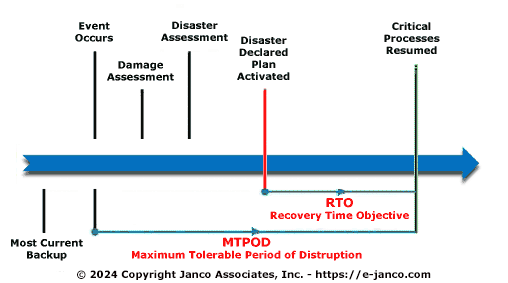
Maximum Tolerable Period of Disruption
Disaster Recovery Guide
Common Mistakes
Why Disaster Recovery Business Continuity is not complete and or inaccurate
Weather


Disaster Recovery Planning is Key to Business Continuity
Exposure Types

ISO 27000, SOX, PCI-DSS & HIPAA Compliant

Order DRPSample DRP

The Standard for Business Continuity and Disaster Planning

Enterprise & World LicenseDRP Customers
    

Janco's Disaster Recovery Planning (DRP) Template can be used for any size of enterprise. The Disaster Recovery template and supporting material have been updated to be Sarbanes-Oxley and HIPAA compliant. The Disaster Planning Template comes as both a Word document and a static fully indexed PDF document and includes:

  • Disaster Recovery Planning and Business Continuity Planning Template,
  • Business and IT Impact Analysis Questionnaire,
  • Work Plan,
  • Disaster Recovery / Business Continuity Audit Program, and
  • Pandemic Planning Checklist.

Preparation for Disaster Recovery / Business Continuity in light of SOX has two primary parts. The first is putting systems in place to completely protect all financial and other data required to meet the reporting regulations and to archive the data to meet future requests for clarification of those reports. The second is to clearly and expressly document all these procedures so that in the event of a SOX audit, the auditors clearly see that the DRP exists and will appropriately protect the data.

New are (Version History):
  • Backup & Backup Retention Policy,
  • Disaster Recovery Audit Program,
  • Compliance with the ISO 27000 Series Standards (formerly ISO 17799 now ISO 27001 & ISO 27002), Sarbanes-Oxley, PCI-DSS, and HIPAA,
  • Web Site Disaster Recovery Planning Form,
  • Project Status Report Form,
  • Personnel Location Report,
  • Department Disaster Recovery Activation Workbook,
    • Quick Reference Guide,
    • Team Alert List (Form),
    • DRP Team Responsibilities,
    • DRP Team Checklist,
    • Critical Function(s) Definition,
    • Normal Business Hour Response Procedures,
    • After Hours Response Procedures,
    • DRP Location(s) Definition,
    • DRP Recovery Procedures,
    • Notification Procedures,
    • Notification Call List (Form),
  • Updated Business and IT Impact Analysis Questionnaire,
  • Vendor Disaster Recovery Questionnaire,
  • Vendor Phone List Form Updated,
  • Key Customer Notification Form,
  • Critical Resources to be Retrieved Form,
  • Business Continuity Off-Site Materials Form, and
  • Business Continuity Audit Program,
The premium edition contains full job descriptions. They are:
  • Chief Information Officer
  • Chief Security Officer
  • Chief Compliance Officer
  • VP Strategy and Architecture
  • Director Disaster Recovery and Business Continuity
  • Director e-Commerce
  • Director Media Communications
  • Manager Disaster Recovery
  • Manager Disaster Recovery and Business Continuity
  • Disaster Recovery Coordinator
  • Disaster Recovery - Special Projects Supervisor
  • Manager Database
  • Capacity Planning Supervisor
  • Manager Media Library Suppor
  • Manager Site Management
  • Pandemic Coordinator


Order DRP BCPSample DRP BCP


DRP / BCP News


Disaster recovery and business continuity still a struggle for many CIOs

February 2nd, 2012

Organizations of all sizes are struggling with getting some of the basics of disaster recovery and business continuity right. They still need support in obtaining executive buy-in, managing resources and implementing easy to use and reliable technology. To some extent, there is still a lack of best practices being provided by vendors, and many SMBs rely heavily on their channel partners to be their best practices advisors to help them make the right choices.

Preparing for Disaster

What has made the world more complex is the fact that organizations are now presented with three different platforms for their disaster recovery strategies: physical, virtual and cloud. Each platform has its own unique challenges and benefits. Some organizations will opt to keep purely physical, others will add virtualization while many will embrace all three.

Order Disaster Plan TemplateDisaster Plan Template

Ultimately the success of any company's backup and DR is based on the availability of its systems and data and the impact that downtime has in terms of lost revenue and lost customers, regardless of the environment data and systems are held in. Using multiple different solutions to manage data across physical, virtual and cloud environments makes this process unnecessarily complicated and risks wasting valuable time and resources.

For most small to medium size businesses, a service's success is underpinned by its ability to deliver ease of use, cost effectiveness and flexibility, and by its ability to implement measures quickly enough to affect a near immediate positive impact. Both cloud services and virtualization can do this, so the future is bright. Managed in the right way, from one central, easy to use solution, they can offer businesses the ultimate backup and disaster recovery protection, ensuring that business continuity becomes easier to manage.

For IT managers, Janco encourages them to compare their backup and DR practices against their counterparts.

- more info


Mobile devices are the bane of many CIOs concerns

January 27th, 2012

Mobile Device UseAs more companies embrace the broad usage of individually-owned mobile devices for access to corporate applications and data, CIO are asked for guidance on the establishment of an associated device usage policy.

Every organization needs to identify and develop mobile security policies to be deployed which will provide adequate protection. The level of protection has to be aligned with the level of risk that your organization is willing to accept. These policies should ensure that the many regulatory or compliance concerns that might be applicable are addressed.

Order Mobile Device Access Use PolicySample Outsourcing Policy

Only by a partnership of information technology (IT), human resource (HR), finance, and legal teams - working closely with your executive team and business unit managers - can determine the exact corporate liable and/or individual liable policy that best fits your company, meets its financial goals and objectives, and takes into account security, legal, regulatory, tax, or other requirements and considerations that may uniquely apply to your company and its operations.

- more info


Will IT spending increase in 2012

January 14th, 2012

IT spending is expected to increase in 2012. After years of budgets crimped by the economy, there is significant pent-up demand at companies around the globe to drop some extra cash for the products and services they’ve been waiting for to drive business forward. But we’ve heard this song before. One research fiorm that  was bullish on IT spending last year, said that it could rise somewhat significantly in 2012, yet in its latest report the research firm acknowledges that its estimates might have been too optimistic. Global spending on IT spending will still be up, the company says, but don’t expect it to rise too quickly.

Janco has found that consultants and contractors are starting to be hired again.

IT Hiring Trends


The salary survey is updated twice a year; once in January and then again in July. You can get a free copy of the full survey if you provide 10 valid data points and use a corporate email address. Free email accounts like gmail or yahoo do not qualify as we have no way to verify the accuracy of the data provided.

The report is updated twice a year, once in January and second time in July. The unemployment data on this page is updated at least once a month and is based on the Bureau of Labor Statistics data.

Order Salary Survey     Free Salary Survey


- more info


New Facts of Life For the CIO and IT Management

January 8th, 2012

The world has changed and the CIO and IT managers need to face the new realities.  They include:Salary Survey IT

  • iPhone and Tablet are here to stay
  • CIO and IT department no longer are in control of how technology is used by you enterprise
  • There will always be some downtime
  • Systems will not be 100% compliant all of the time
  • The cloud will not be the solution for all problems and will case new ones
  • There will never be enough capital and staff to get what needs to be completed done
  • The network has already been compromised
  • Social networking use risks all of your company's secrets
  • Users will always need your support even for technology that you have not implemented
  • IT will continue to be viewed as a service organization
- more info


Compliance Best Practices

January 4th, 2012

Security compliance best practices include:Compliance Best Practices

  • Combine written content, usage, and retention policies with a Hosted Managed Email Archiving Service to ensure an organization's ability to preserve, locate, and produce legally valid email evidence. Unmanaged email and other record management solutiond can trigger financial, productivity, and legal issues for your organization when it a finds itself in a workplace lawsuit. The cost and time required to produce subpoenaed email, retain legal counsel, secure expert witnesses, mount a legal battle, and cover jury awards and settlements is ver costly. Best practices call for a proactive approach to email and business records management.
  • Utilize a proven archiving technology to ensure forensic compliance. For example, by encrypting and archiving a copy of every business record and internal and external email sent or received and across the organization, a Hosted Managed Email Archiving Service solution guarantees that your email is secure and tamperproof. Nothing in your archive can be deleted or altered. Everything in your archive is legally compliant.
  • Ensure that financial data and related documents are effectively protected from malware, viruses, and other malicious intruders - and are preserved in a legally compliant manner in order to  maximize SOX, GLBA, SEC, FINRA, and PCI DSS compliance. This includes having solutions in place to manage messaging threats and compling with regulatory requirements including Email Anti-Virus, Email Archiving, Email Continuity, and Email Content Control.
  • Meet HIPAA requirements by using formal policies, employee training, and technology including email
    Archiving, Anti-Virus, Continuity, and Content Control Services to ensure compliant use of email to transmit and store HIPAA-regulated patient information.
  • Safeguard personal or sensitive data whose transmission falls under state encryption laws or other privacy acts by deploying proven solutions that are designed to effectively identify personal information in any electronic transmission and, if necessary, block or encrypt the transmission.
  • Reduce business and security risks associated with electronic communication by implementing a formal electronic communication policy that combines a written policy with employee training.
- more info