IT Salary Survey Benefits Provided
Are you paying too much or too little to your IT staff? Do you have IT job descriptions? Are you earning what you're worth? Whether employer or employee, it is important to know what other companies are paying in total compensation for a similar position in your area. Learn how your company compares in the area of compensation.
The Janco Associates, Inc. salary survey draws on data collected throughout the year by extensive internet-based and completed survey forms sent to businesses throughout the United States and Canada. Our database contains over 50,000 data points
The compensation study (over 155 pages in PDF or WORD and EXCEL with the data) can be ordered here.
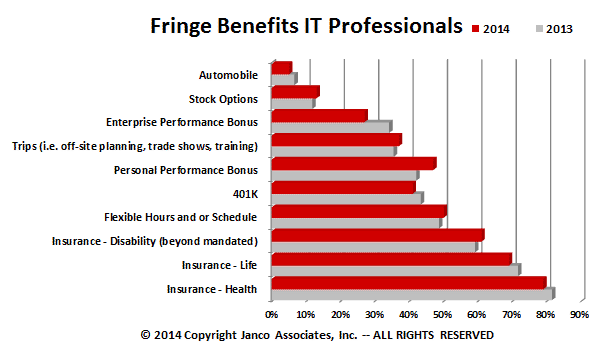
Fringe Benefits for IT Professionals
Companies have started to cut back on the fringe benefits provided to IT Professionals. For example in January of 2008 95% of IT professionals had health insurance supplied by their employers while in June 2009 only 88% did. A full historical comparison of trends in benefits is included with the full version of the Janco IT Salary Survey.

IT Fringe Benefit and Salary News
CIO begin to think about growing the their IT organizations
According the Hackett Group's, company leaders have identified the need to grow their emerging market presence as one of the most important priorities for 2012, compared to 2011. They now want their current level of globalization to triple within two to three years, and among their top goals is expanding the reach of their IT service delivery models.
But simply growing and tapping new markets isn't enough. Companies want to remain agile so they can adapt quickly and intelligently to volatile changes in customer demands and costs, according to the firm. "Getting the right information to permit quick action can only be accomplished when mechanisms are in place to gather high-quality data, conduct rigorous analysis, and make decisions with confidence. IT and other support functions overwhelmingly recognize this fact and are focusing their technology priorities for 2012 around the themes of improving the foundation of unified data (to create 'one source of truth') and being able to provide analysis and access to those findings."
- more infoH-1B Visa program continues to grow

The data comes from the U.S. Citizenship and Immigration
Service. One list shows new applications for H-1B visas; the second list shows
the combined totals for new visas and renewals. A H-1B visa must be renewed
every three years.
The U.S. issues 85,000 H-1B visas annually. Of that number, 20,000 are reserved for advanced degree graduates of U.S. universities.
In total, the new visa applications from the top 10 users account for 22% of all the visas allowed by the U.S. each year. But offshore providers probably have a much larger percentage of the visas issued under the 65,000 cap, which includes graduates for foreign universities. An exact breakdown isn't available.
H-1B Visa Renewals and Approvals
- Cognizant - 5715
- Infosys- 4042
- Wipro - 2817
- Tata - 1758
- Larsen & Toubro - 1608
- Microsoft - 1586
- Accenture - 1370
- HCL America - 1128
- IBM - 1063
- Google - 615
H-1B New Visa Applications
- Cognizant - 4222
- Infosys - 3962
- Wipro - 2736
- Tata - 1740
- Accenture - 1347
- Larsen & Toubro - 1204
- HCL America - 1033
- Microsoft - 947
- IBM - 853
- Google - 383
- TOTAL - 18427
Recruiting using social media
Social media sites provide distinct clues that help identify top talent. Look at the candidate's presence on Linked In, Facebook, Twitter, or blogs, and look at:
- Writing style: Many top-tier recruits have blogs with at least a small readership. Take the time to read his or her blog posts - and not just the most recent ones, but the early ones as well. It will give you an idea about his or her professionalism, communication skills, and ability to evolve and progress.
- Followings: A good way to differentiate between two seemingly equal candidates may be to see how many people are commenting on their blog and, more significantly, how many followers they have on Twitter. Followers are a rough vote of interest and confidence in an individual.
- Word of mouth - online: Wall posts, Twitter @replies, blog comments, and LinkedIn recommendations provide insight into what people think of an individual.
Social media has proven to be a valuable resource in bad times, and it may
also be a compelling resource for businesses in times-a-plenty. Tracking
potential talent across social media venues is smart business because the top
players in any industry or profession are likely to be actively engaged in
online communities.
Talent in high demand at large firms
CIOs and other top organizational executives foresee a global talent shortage looming for the next several years, according to recent research from Deloitte. The consulting firm released the results of its survey in a new report, "Talent Edge 2020: Redrafting Talent Strategies for the Uneven Recovery." When it comes to adequately appointing leaders and staffing key operations, the report says fallout from the talent shortage could be significant. In addition, retaining younger workers has emerged as a key issue for many organizations.
Ultimately, companies that invest aggressively in talent management and development programs will reap rewards, the report concludes. "Today's top talent organizations are not sitting back and waiting for a slow recovery to solve their talent challenges," says the talent services leader for Deloitte Consulting. "These executives are more likely to invest ‑ by a two to one margin ‑ across the board on talent priorities." More than 375 senior executives and talent managers at large companies worldwide took part in the research.
- more infoHiring is on the uptick
Janco Associates and eJobDescription.com have found that hiring seems to be on the move up. In the last few months they have found that companies are beginning to look into the future.
- more infoMobile workers to drive IT
By 2015,
the world's mobile worker population will reach 1.3 billion, representing 37.2
percent of the total workforce, according to an updated forecast from an IT
analytics firm. The report projects the most significant gains will again be in
the emerging economies of Asia/Pacific thanks to continued, strong economic
growth. The Americas will experience a slower growth rate due to a protracted
economic recovery and high rates of unemployment, the analysts
concluded.
This bundle contains the following policies:
- CIO IT Infrastructure Policy Bundle
- Backup and Backup Retention Policy
- Blog and Personal Web Site Policy
- Incident Communication Policy
- Internet, e-Mail, Social Networking, Mobile Device, Electronic Communications, and Record Retention Policy
- Mobile Device Access and Use Policy
- Outsourcing Policy
- Record Management, Retention, and Destruction Policy
- Sensitive Information Policy (HIPAA Compliant)
- Service Level Agreement (SLA) Policy Template with Metrics
- Social Networking Policy
- Telecommuting Policy
- Travel and Off-Site Meeting Policy
http://www.e-janco.com/Salary.htm
The 2012 Salary
Survey, just released by Janco Associates, is mixed news for IT
Professionals. The survey shows that hiring and salaries are up in some
sectors of the IT job market, salaries have stopped falling and for selected
positions there has been an increase in compensation.
The CEO of Janco stated, "Our main conclusion from analysis of the data and interviews of CIOs is that for Information Technology the recession has bottomed out for and that hiring of IT professionals will increase in 2012." He also said, "However there still are a number of companies who are continue to be cautious and are concerned that the recovery will not be strong enough to support increased IT spending." He added, "Cost control is still the rule of the day; however we have seen an increase in the number of part-timers and contractors who are focused on particular critical projects. This is strong indicator that IT hiring and salaries will go up in 2012."
- more info42% CIO report to the CFO
The Financial Executives Research Foundation found that 42% of IT organizations report directly to the CFO. The percentage soars to 60% at smaller businesses with revenues between $50 million and $250 million.
The same survey pointed out that finance chiefs alone authorize 26% of all IT investments, while chief information officers approve only 5%. This makes sense: in tough economic times finance inevitably asserts itself and casts a gimlet eye on spending. In fact, an October 2011 report by CDW, one of the worlds largest technology resellers, said that only 40% of IT decision-makers expect their budgets to rise this winter, down 8% from last year and the lowest level of IT investment increase since October 2009.
- more infoOvertime may be thing of the past for ALL IT workers
The Computer Professionals Update Act (CPU Act) was proposed by a Democrat, Sen. Kay Hagan, whose state is home to a heavy concentration of technology-related companies, as well as financial services outfits, including Bank of America, that are huge employers of IT workers.
The bill would amend the Fair Labor Standards Act (FSLA), which mandates that workers be paid time-and-half for work beyond 40 hours in a week -- in some cases, beyond 8 hours in a day. There are already numerous exemptions to that requirement, including salaried executives, professionals, and any IT worker "who is a computer systems analyst, computer programmer, software engineer, or other similarly skilled worker." The current version of the FSLA goes on to specify that exempt-from-overtime jobs include "systems analysis techniques and procedures design, documentation, testing, creation, or modification of computer programs."
The CPU Act would broaden that exemption so much it appears that any IT worker who is paid more than $27.63 an hour would lose the right to overtime. Here's what it says:
Any employee working in a computer or information technology occupation (including, but not limited to, work related to computers, information systems, components, networks, software, hardware, databases, security, Internet, intranet, or websites) as an analyst, programmer, engineer, designer, developer, administrator, or other similarly skilled worker, whose primary duty is
- the application of systems, network, or database analysis techniques and procedures, including consulting with users, to determine or modify hardware, software, network, database, or system functional specifications; or
- the design, development, documentation, analysis, creation, testing, securing, configuration, integration, debugging, modification of computer or information technology, or enabling continuity of systems and applications.
Security jobs may be in high demand
IT security professionals are projected to see higher salary
increases, compared with the overall IT market in 2012, according to one
national recruiting firm.
Salaries for IT security professionals are projected to increase by 4.5 percent in 2012, according to this firm. The increasingly hostile threat landscape and growing demand for cloud computing has made security the hottest IT career in terms of salary growth.
The guide listed projected percentage increases over 2011 salaries as well as estimated base salaries. The IT salaries in general are expected to see a 3 percent increase in 2012; security jobs are expected to outpace the projected average.
- more infoDumb move by creater of CityVille and FarmVille soical network games
Attracting top employees is difficult for cash-strapped startups. To address this many of these companies give out company stock to supplement salaries that employees might feel is below-market.
Zynga followed that strategy. The creator of CityVille and FarmVille, Zynga apparently wishes it hadn't, according to a the Wall Street Journal.
The Zynga CEO, along with his top executives, decided last year as they were preparing for an initial public offering (IPO) that they had given out too much stock to employees. But rather than accept that reality, the executives reportedly tried a different tactic: demand employees give back not-yet-vested stock or face termination.
In order to determine which employees would be asked to give stock back, Pincus and his executives tried to pinpoint workers whose contributions to Zynga--in the execs' eyes--didn't necessarily justify the potential cash windfall they could receive when the company went public, the Journal claims. One Journal source said that Zynga executives were especially concerned with not creating a "Google chef" scenario.
That reference relates to Google's 2004 IPO when one of the company's chefs, who was hired in the firm's early days, walked away with $20 million worth of stock after the shares went public.
After finding people to target, the Journal's sources say, the CEO offered his ultimatum. However, as one might expect, he faced some anger from employees who didn't believe they should be required to give back the stock. The Journal cited two employees--one who has left Zynga and another that still works with the company--who hired attorneys to reach a settlement that saw them give up some, but not all, of the unvested shares.
- more infoApple reacts to Job's passing
Apple last week awarded six senior executives $60 million each in stock contingent on them staying with the company through mid-March 2016.
In a filing with the U.S. Securities and Exchange Commission (SEC) last Friday, Apple said it had granted 150,000 restricted stock units to each executive. At the close of trading Friday, the options were worth just over $60 million.
Those awarded the grants included chief financial officer Peter Oppenheimer, general counsel Bruce Sewell and senior vice presidents Scott Forstall, Philip Schiller, Bob Mansfield and Jeffrey Williams.
Forstall heads Apple's iPhone software group, Schiller is Apple's chief marketing officer, Mansfield leads the company's hardware engineering efforts, and Williams is the head of operations, responsible for the work once done by now-CEO Tim Cook.
Eddie Cue, another senior vice president who oversees all online work at Apple -- including the App Store and iCloud -- was awarded 100,000 restricted stock units that vest in September 2014 and September 2016.
In September 2011, Cue was given a grant of 100,000 shares when he was
promoted to senior vice president.
Steps to take before starting the termination process
When stating the process of terminating an employee it is important to have a process in place to justify the termination and will help to minimize the exposure to wrongful termination lawsuits.
- Hire the right person for the job Sometimes
managers are so desperate to fill positions that they bring candidates on
board who aren't the best fit for the jobs. That often sets up the individual
for failure and leads to termination.

- Manage all employees' performance Many managers
think it's too hard to coach people or to have those difficult, direct
conversations with employees about the behavior that needs to change. But
failing to train an employee or set clear expectations with the employee about
his or her performance can lead the employee to allege wrongful termination.
Most people want to know if they're doing something wrong that could possibly
get them fired. They need an opportunity to correct it before the employer
terminates them
- Make jokes or disparaging comments about the employee and or
their performance Comments about employees should not
"cross the line". Not only can they hurt the employee but they could be
used to define a hostile work environment which in turn can put your company
at risk. The same is true for nicknames.
- Inform employees of the consequences (they could be
terminated) for not improving their performance Managers
need to not beat around the bush with employees during conversations about
their performance. Managers need to be clear that whatever the employee is
doing or not doing could result in termination.
Employers should not leave employees guessing that they're at risk for termination. A termination for a performance or behavioral issue should never be a surprise. Managers have a hard time saying these words, but they need to be clear about the severity of the situation because most employees operate under the assumption that everything is fine even though they know their boss would like them to work a little bit better or faster.
- Document performance - both good and bad If
there have been problems with an employee, it must be reflected in performance
reviews and if not, you must be write up employees' performance deficiencies.
Many managers terminate employees for cause after having multiple
conversations with employees about their performance, but they never document
any of these conversations in employees' personnel files. Without
documentation an employee has a stronger case for wrongful
termination.
- Make inappropriate comments about the employee via email or
social networks Managers need to be careful about the things they
write in emails regarding employees whose performance may warrant termination.
Emails are all discoverable in a case. Those are documents that could become
public.
- Give employees appropriate notice Under the WARN (Worker Adjustment and Retraining Notification) Act, employers with 100 or more full-time employees that are closing a facility and laying off at least one-third of their workforce are required to give those employees 60 days' notice of the layoff.
Criteria for hiring direct reports to the CIO
Among the multiple hats CIOs wear, "hiring manager" doesn't
always lie at the top of the priority list, transcending fundamental concerns
like implementing new technology and meeting compliance requirements. But since
IT chiefs will surely interview candidates for key positions on their staffs,
and a poor choice could be quite damaging, it could be invaluable to know about
the psychological aspects of interviews and how to tell high performers from
poor ones.
First, even for IT roles, technical skills may be an overblown component of selection criteria. A consulting firm monitored hiring effectiveness and employee engagement at 1,500 companies across many industries and tracked 20,000 new hires over a three-year period. Among the 46% of hirees who failed within their first 18 months, only 11% failed because of technical incompetence. The other 89% failed in attitudinal areas: coachability, emotional intelligence, motivation, and temperament.
- more infoRetirement is now a far away dream for many IT Pros
Americans have emerged from the economic recession with a new set of expectations around the purpose, timing and funding of their retirement. Not only is retirement being postponed, but it no longer means an end to workingretirement is now a new chapter in life.
Expectations for retirement have changed in the wake of the Great Recession. Forget moving someplace warm and sipping margaritas between golf and shuffleboard games; the "New Normal" for Americans involves less wealth and more work, says a survey from SunAmerica Financial Group, which focused on people aged 55 and older.
Still, the research shows people as more upbeat and philosophical than
pessimistic, with a sense that the new experience of retirement can be
fulfilling. "Americans are emerging from the experience with new knowledge, new
discipline and have re-set their vision of an ideal retirement," says the
president/CEO of SunAmerica Financial Group. "Americans have also proven
themselves to be both resilient and resourceful. They are course-correcting:
intending to work longer, save more, spend less, be more disciplined and adjust
their lifestyle expectations."