
Disaster Recovery Plan Template Business Continuity
2025 Edition contains major additions - Addresses How to Implement AI
DRP BCP Tool Kit fully integrated with Janco's IT Infrastructure Policies - Cloud DR/BC supported
ISO 27000, CCPA, GDPR, SOX, PCI-DSS & HIPAA Compliant
The Standard for Disaster Planning and Continuity Planning - Just added WFH & Telecommuting Policy and job descriptions for Chief Compliance Officer and Chief Mobility Officer
 Over 3,000 Companies World Wide have chosen this DRP/BCP Template - comes in MS Word, ePub (eReaders), and PDF formats.
In most organizations, Disaster Recovery Planning is the quintessential complex, unfamiliar task. Disasters happen so rarely that recovery operations are the opposite of routine. What's more, the myriad interconnected data, application and other resources that must be recovered after a disaster make recovery an exceptionally difficult and error-prone effort. Even if you have never built a Disaster Recovery plan before, you can achieve great results. Just follow the DR Template that Janco has created and you will have a functioning plan before you know it.
Order DRP BCP Template Sample DRP BCP Template History
All Business Continuity Disaster Recovery Planning efforts need to encompass how employees will communicate, where they will go and how they will keep doing their jobs. The details can vary greatly, depending on the size and scope of a company and the way it does business. For some businesses, issues such as supply chain logistics are most crucial and are the focus on the plan. For others, information technology may play a more pivotal role, and the Business Continuity Disaster Recovery Plan may have more of a focus on systems recovery.
 But the critical point is that neither element can be ignored, and physical, IT and human resources plans cannot be developed in isolation from each other. (In this regard, Business Continuity Planning and Disaster Recovery Planning have much in common with security convergence.) At its heart, Business Continuity Planning and Disaster Recovery Planning processes are about constant communication.
The Disaster Recovery Plan (DRP) is that tool which can be used as a Disaster Planning Template for any size of enterprise. The Disaster Planning Template and supporting material have been updated to be GDPR,CCPA, Sarbanes-Oxley and HIPAA compliant. The template comes as both a Word document, a static fully indexed PDF document, and as an electronic book in .epub format. The Disaster Planning and Business Continuity Planning Template include:
- Disaster Recovery Plan and Business Continuity Template (WORD and PDF)
- Ransomware guidelines that meet all mandated compliance requirements
- Business and IT Impact Analysis Questionnaire
- Work Plan
- Disaster Recovery and Business Continuity Audit Program
- Pandemic Planning Checklist
- Vendor Partner DR/BC Questionnaire
- Full integrated IT Infrastructure Policies
- Backup and Backup Retention Policy
- Incident Communication Plan Policy
- Physical and Virtual (Cloud) Security Policy
- Social Networking Policy
- WFH & Telecommuting Policy
- Electronic Forms
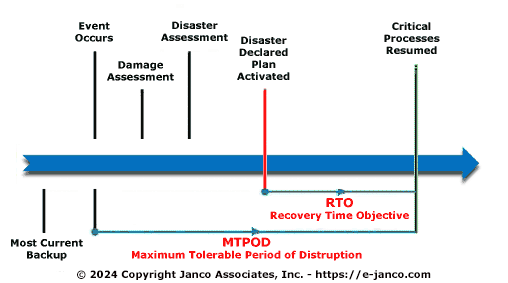
Preparation for Disaster Recovery and Business Continuity in light of mandated requirements has two primary parts. The first is putting systems in place to completely protect all financial and other data required to meet the reporting regulations and to archive the data to meet future requests for clarification of those reports. The second is to clearly and expressly document all these procedures so that in the event of a SOX audit, the auditors clearly see that the Disaster Recovery and Business Continuity Plan exists and appropriately protects the data and assets of the enterprise.
The Disaster Recovery - Business Continuity Template purchase options are
 Disaster Recovery Business Continuity Standard Edition
Artificial Intelligence Considerations
Disaster Recovery Business Continuity Template (WORD) - comes with the latest electronic forms and is fully compliant with all mandated US, EU, and ISO requirements.
- Fully editable Disaster Recovery Business Continuity template
- Disaster Recovery Business Continuity Audit Program - Compliant with ISO 27031, ISO 22301, and ISO 28000
- Key job descriptions included
- Chief Compliance Officer
- Chief Experience Officer
- Chief Mobility Officer
- Manager Disaster Recovery & Business Continuity
- Manager Disaster Recovery Manager
- and more
- Incident Communication Plan and Policy with BEST PRACTICES for
- News Conferences
- Media Relations
- Social Network Checklist
- Included with the template are Electronic Forms which have been designed to lower the cost of maintenance of the plan. Electronic Forms that can be e-mailed, completed via a computer or tablet, and stored electronically including:
- LAN Inventory, Location Contact Numbers, Off-Site Inventory, Pandemic Planning Checklist; Personnel Locations, Plan Distribution, Remote Location Contact Information, Server Registration, Team Call List, Vendor Contact Information, and Vendor/Partner Questionnaire
- Added Bonus - Safety Program Electronic Forms -- Area Safety Inspection, Employee Job Hazard Analysis, First Report of Injury, Inspection Checklist - Alternative Locations, Inspection Checklist - Office Locations, New Employee Safety Checklist, Safety Program Contact List, and Training Record
Disaster Recovery Business Continuity Premium Edition
- Disaster Recovery Business Continuity Template
- 23 Job Descriptions (WORD)
Chief AI Officer - CAIO, Chief Information Officer - CIO, Chief Security Officer - CSO, Chief Compliance Officer - CCO, Chief Digital Officer, Chief Mobility Officer, VP Strategy and Architecture, Director Disaster Recovery and Business Continuity, Director e-Commerce, Director Media Communications, Manager Disaster Recovery, Manager Disaster Recovery and Business Continuity, Disaster Recovery Coordinator, Disaster Recovery - Special Projects Supervisor, Manager Database, Capacity Planning Supervisor, Manager Media Library Support, Manager Record Administrator, Manager Site Management, and Pandemic Coordinator
Disaster Recovery Business Continuity Gold Edition
- Disaster Recovery Business Continuity Template - Full template with all of its attachments.
- 334 IT Job Descriptions including all of the job descriptions contained in the Premium edition.
With this offer you save almost 50% from the base price of these two very popular products
 Disaster Recovery Business Continuity & Security Manual Templates Standard
- Disaster Recovery Business Continuity Template
- Security Manual Template
Both of the templates have been recently updated to meet new compliance requirements for ransomware, EU madated issues and BREXIT operational considerations
"Best of Breed - Best Practices Disaster Recovery Planning / Business Continuity Planning and Security Policies" according to the IT Productivity Center
Disaster Recovery Business Continuity & Security Manual Templates Premium
- Disaster Recovery Business Continuity Template - Standard Edition
- Security Manual Template - Standard Edition
- 41 Job Descriptions including:
CIO; CCO; Chief Digital Officer, Chief Experience Officer, Chief Mobility Officer, CSO; VP Strategy and Architecture; Data Protection Officer, Director e-Commerce; Database Administrator; Data Security Administrator; Manager Data Security; Manager Database; Manager Disaster Recovery; Manager Disaster Recovery and Business Continuity; Pandemic Coordinator; Manager Facilities and Equipment; Manager Media Library Support; Manager Network and Computing Services; Manager Network Services; Manager Site Management; Manager Training and Documentation; Manager Voice and Data Communication; Manager Wireless Systems;Capacity Planning Supervisor; Disaster Recovery Coordinator; Disaster Recovery - Special Projects Supervisor; Network Security Analyst; System Administrator - Unix; System Administrator - Windows
Disaster Recovery Business Continuity & Security Manual Templates Gold
- Disaster Recovery Business Continuity Template - Standard Edition
- Security Manual Template - Standard Edition
- 334 Job Descriptions which includes all of the job descriptions in the premium edition
"Best of Breed - Best Practices Disaster Recovery Planning / Business Continuity Planning, Security Policies, IT Job Descriptions" according to the IT Productivity Center
Disaster Planning Template General Description
The Disaster Planning Template is over 240 pages and includes everything needed to customize the Disaster Recovery Plan to fit your specific requirement. The electronic document includes proven written text and examples for the following major sections of a disaster recovery plan:
- Plan Introduction
- Business Impact Analysis - including a sample impact matrix
- DRP Organization Responsibilities pre and post disaster - DRP / BCP checklist
- Backup Strategy for Data Centers, Departmental File Servers, Wireless Network servers, Data at Outsourced Sites, Desktops (In office and "at home"), Laptops and PDA's.
- Recovery Strategy including approach, escalation plan process and decision points.
- Disaster Recovery Procedures in a check list format
- Plan Administration Process
- Technical Appendix including definition of necessary phone numbers and contact points
- Job Descriptions
- Chief Compliance Officer
- Chief Experience Officer
- Chief Mobility Officer
- Disaster Recovery Planning Manager
- Manager Disaster Recovery Planning and Business Continuity Planning
- Pandemic Coordinator
- Work Plan to modify and implement the template. Included is a list of deliverables for each task. (Risk Assessment and Vulnerability Assessment)
- Disaster Recovery Planning Manager Responsibilities
- Distribution of the Disaster Recovery Plan
- Maintenance of the Business Impact Analysis
- Training of the Disaster Recovery Team
- Testing of the Disaster Recovery Plan
- Evaluation of the Disaster Recovery Plan Tests
- Maintenance of the Disaster Recovery Plan
Click on the link below to get the Disaster Planning and Business Continuity Planning Template full table of contents and selected sample pages now and make it part of your Disaster Recovery Planning toolkit. Order the template with no risk with our full refund policy.
Order DRP BCP Template Sample DRP BCP Template
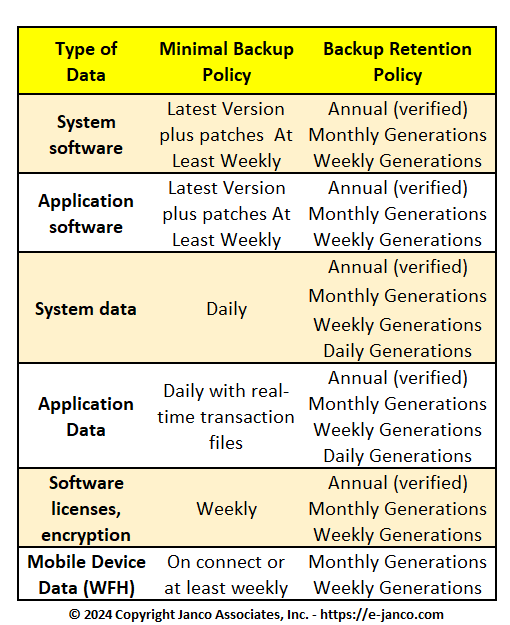
Backup Matrix - Sample from Disaster Planning Template
Order Disaster Plan Template Download DRP Customer Base
Testimonials
Testimonial - Dave Baker - City of Hamilton -I have found the DRP template invaluable!
Testimonial - Bob Rifenbury -mCSE/CCNA Launch Testing Lab -The DRP Template saved me about 6 months of work!
Testimonial - Kelly Keeler - Martin's Point Health Care -Once delivered, I began using the template immediately. IT IS GREAT! Made this process a snap for me. Cut my documentation time down from weeks to hours! This document has made, what began to be an overwhelming process turn into a snap!
Testimonial - Juan Stamos - Mexico City Corporation -We had a DRP in place, but needed a more user friendly structure. The Disaster Recovery Template (Gold edition) has that structure. It was very easy to quickly move our DRP into Janco's DRP Template -- a real added value.
This template is not for resale or re-distribution - Disaster Plan Template, Disaster Recovery Planning Template Disaster Recovery Template, Disaster Recovery
Order DRP BCP Template Sample DRP BCP Template
