

CSO
Chief Security Officer
Changing Role
The primary objectives of the enterprise information security effort and the Chief Security Officer (CSO) are:
- Ensuring the confidentiality of sensitive information processed by, stored in, and moved through information systems and applications belonging to the enterprise. Examples of sensitive information processed by enterprise include personally identifiable information and other Privacy Act protected records; pre-release economic statistics; information provided by companies and individuals under the assumption of confidentiality; and pre-award contract financial information.
- Ensuring the integrity of the enterprise information such that decisions and actions taken based upon the data processed by, stored in, and moved through enterprise information systems can be made with the assurance that the information has not been manipulated, the information is not subject to repudiation, the source of the changes to information can be determined as best as possible.
- Ensuring the availability of the enterprise information systems and applications during routine operations and in crisis situations to support the enterprise Mission.
Chief Security Officers (CSOs) have many issues they must address when looking at overall security of the enterprise and the IT function. One of traditional ones is security monitoring. Security monitoring spans three areas of operations: monitoring operations (the running status); monitoring traffic (both in and out); and monitoring the results of use (keeping logs, statistics, and analysis). This encompasses monitoring physical hardware, server performance, services, and the network.
Issues with Security Monitoring:
- Determining what needs to be monitored
- No clear and holistic view of the data
- Too many - or too few - "agents" for the job
- Too many manual tasks
- Too much complexity and hidden costs
- Hodgepodge of low-end tools
The job descriptions created by Janco's executive consultants have taken these changes in role into consideration when the job description for the CSO was updated. The Chief Security Officer job description is over 4 pages in length.
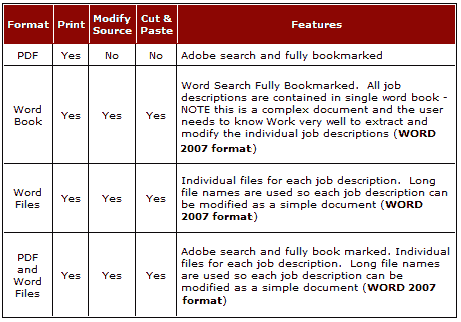
You can purchase this book as a PDF Book, Word Book or as individual word files for each Job Description (in both WORD 2003 .doc and WORD 2007 .docx formats) which makes for easier modification. We have also combined the both book formats with the individual word files for each job descriptions to give you the best of both worlds.
Chief Security Officer News
IT Professionals are satisfied in their jobs but are looking
The vast majority of IT professionals are satisfied at work with 40 percent are satisfied with their jobs. Indeed, Janco finds that there is a direct correlation between job satisfaction and the salary. Since more money equals greater job satisfaction, one could infer that for some, money does buy happiness.
However, more than 60% of IT Professionals feel they should be
making more money.
Though the majority of IT professionals seem to be
satisfied with their current jobs, it is not preventing almost 40% of them to
start looking for new opportunities. Nearly 1 in 5 are either actively
looking or will be looking within the next three
months.
Could proposed fed policy help IT Hiring
Several Republican senators and procurement experts have voiced their disagreement with a policy Obama administration officials are considering that would give a leg up to contractors who pay their employees more, according to a letter and comments at a hearing.
"We are concerned that the imposition of these requirements, during a time of significant economic turmoil in the private sector and tight federal budgets, could have serious, negative consequences, especially for our nation's small businesses," five senators wrote in a letter to the director of the Office of Management and Budget.
Today, an Obama administration official said the president hasn't issued any policy regarding a contracting preference. Nevertheless, experts inside and outside of government have offered suggestions to the administration on improving contracting, as the president pledged to do in his reform memo.
- more infoArmy to reduce outsourcing
(Washington Technology) Army Secretary John McHugh told a Senate committee today that the Army plans to give outsourced jobs that are associated with inherently governmental functions to its civilian employees.
The Army intends to insource 7,162 positions this fiscal year, McHugh said in testimony before the Armed Services Committee. From fiscal 2011 to 2015, the service aims to take back 11,084 positions and give them to civilian employees. Of those, nearly 3,988 are for acquisition-related work, he said.
"Civilians are assuming increased responsibilities within the Army," he said.
In fiscal 2009, the Army saved significant resources by bringing back in house more than 900 "core governmental functions," McHugh added.
Core governmental functions, sometimes called critical functions, are jobs that are very close to inherently governmental functions, or work that only a government employee can do. Outsourcing core jobs can force the government to rely on the private sector's knowledge, and contractors potentially can unduly influence the government, officials say.
"The Army is recouping intellectual capital by insourcing former contracted positions,"McHugh said.
The Army identified these positions to insource in its ongoing contractor inventory review process.
Like McHugh, other military officers and Defense Department officials have announced plans in their fiscal 2011 budget proposals to take away numerous jobs from contractors, in areas such as acquisition and procurement.
- more infoBaby boomers face new challenges in the job market
According to the Congressional Budget OfficeOver the past 15 months, the stock market has wiped out $2 trillion in Americans' retirement savings . With the downturn in the stock market and the laying off of so many IT professionals, there now is a situation where "baby boomer" are competing for the same jobs as the "millennials" are just getting out of college.
CIOs now have to decide whom to hire by sorting through a maze of
competing technical expertise, business acumen, cultural preferences, and career
expectations.
That is not always easy. Millennials have a tendency to eat,
sleep and breathe Web 2.0 technologies, and the value of that may not be
immediately clear to a traditional CIO.
Boomers
have expertise in more traditional technologies such as IT infrastructure and
operating systems. That's good news for large enterprises, which are always on
the lookout for IT professionals with the skills needed to support its largely
mainframe-based package-tracking system.
That type of expertise can limit boomers' prospects elsewhere.
This
eagerness to learn gives many millennials a leg up on the competition. There is
a managerial flip side to consider. Young IT workers who are bold enough to take
on new technologies are also more likely to be impatient with the constraints of
traditional workplaces.
Businesses
that expect all employees to march to the beat of the same drummer, however, may
have a tough time reining in millennials' more spirited work ethic and thirst
for experimentation.
Recession impacts IT entry positions the hardest
Take a look at the numbers defining the scope of the recession. When you break down the unemployment rate by age group, here's how it pans out: 16.7 percent for everyone aged 15 to 24, 8.2 percent for everyone aged 25 to 44, and 6.3 percent for everyone aged 45 and older. So, the older you are, the less likely you are to be unemployed.
Federal records show that the older you are, the more money you're likely to be making: The median weekly salary for workers in the 16-to-24 age bracket is about 41 percent less than what someone aged 25 to 44 makes -- and they're making 6 percent less than the folks in the 55-and-up group.
When you look at the numbers in the Janco 2010 salary survey, staff-level salaries start at a median of $40,671 and climb higher as the jobs proceed up the (very short) ladder.
And, unfair as this seems, the more you're making, the less likely you are to be unemployed. According to a new study at Northeastern University's Center for Labor Market Studies, the unemployment rate for people making between $39,000 and $50,000 is 9 percent, and it only drops more as your income climbs: If you're making $79,100 or more, only 3.2 percent to 5 percent of the people in your income bracket have lost their jobs.
- more info